Site Name: Sarai Amanat Khan
Date: 1640-1641 CE
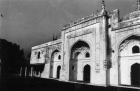
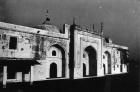
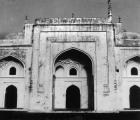
Subject: View of the east facade of the mosque, three-bayed with triple domes, ornate facade, with partially buried lower half, inscribed


 CENTER FOR ART AND ARCHAEOLOGY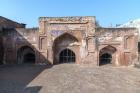
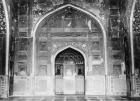
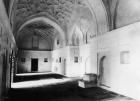
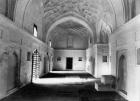
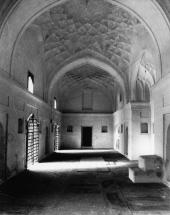
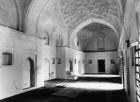
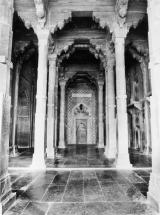
Mosque, west of mausoleum, Interior, nave, central recessed arch: The arches flanking the hall and their linking passages are covered with several designs of ornamental cartouches and interlacing floral scrolls arranged in symmetrical correspondences. The mosque's floor is inlaid with a pattern of prayer mats to create individual spaces for precants.
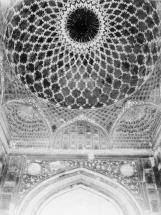
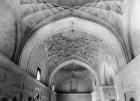
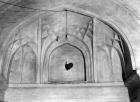
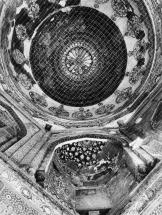
Mosque, west of mausoleum, nave, view showing spandrels, squinches and incised stucco domical ceiling: The dome of the mosque is covered with a diaper pattern creating a whirling effect. The decoration appears as white patterns on the red surface. The design is made with a sgraffito technique: a coat of red plaster is laid over a white one, then the top coat is cut away to expose the desired design in the white layer underneath.
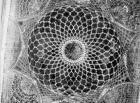
Mosque, west of mausoleum, nave, incised stucco domical ceiling: The dome of the mosque is covered with a diaper pattern creating a whirling effect. The decoration appears as white patterns on the red surface. The design is made with a sgraffito technique: a coat of red plaster is laid over a white one, then the top coat is cut away to expose the desired design in the white layer underneath.
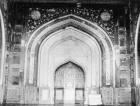
Mosque, west of mausoleum, nave, central recessed arch, spandrels: The central pishtaq is deepened which allows the insertion of flanking rooms connected by linking passages. The dados have a display of flowering plants that recall their marble counterparts in the mausoleum; but since sandstone is more susceptible to corrosion, they are not as well preserved and have been replaced by carved copies.
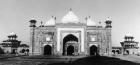
View of the mosque, west of mausoleum: The mosque is based on a standard type which the Mughals took over from the Sultanate architecture of Delhi. It has an oblong massive prayer hall formed by vaulted bays or rooms arranged in a row with a dominant central pishtaq and domes. A large pishtaq is flanked by the standard superimposed niches, though those of the upper storey are blind. There is more intensity of ornamentation and marbling in the center than in the corners. The corners are emphasised by engaged towers topped by chhatris. There are three white marble domes, the walls are covered with the usual multi-cusped blind arches and the dados are surrounded by an inlaid chevron pattern.
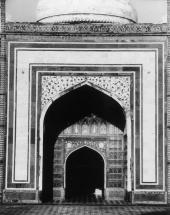
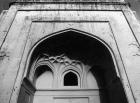
Mosque, west of mausoleum, East facade, iwan
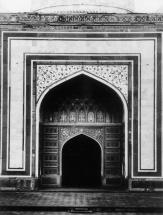
Mosque, west of mausoleum, East facade, iwan
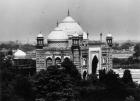
View of the mosque, west of mausoleum: The mosque is based on a standard type which the Mughals took over from the Sultanate architecture of Delhi. It has an oblong massive prayer hall formed by vaulted bays or rooms arranged in a row with a dominant central pishtaq and domes. A large pishtaq is flanked by the standard superimposed niches, though those of the upper storey are blind. There is more intensity of ornamentation and marbling in the center than in the corners. The corners are emphasised by engaged towers topped by chhatris. There are three white marble domes, the walls are covered with the usual multi-cusped blind arches and the dados are surrounded by an inlaid chevron pattern.
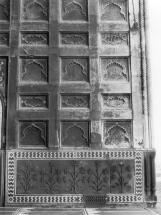
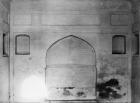
Mosque, west of mausoleum, east facade, iwan, north wall: The mosque has three domed bays which are of hall-like dimensions and made cruciform by arched recesses. All the dados have a display of flowering plants that recall their marble counterparts in the mausoleum; but since sandstone is more susceptible to corrosion, they are not as well preserved and have been replaced by carved copies. Flowers and plants were a form of decoration specially sanctioned by Islamic theologians and so were appropriate for a religious building.
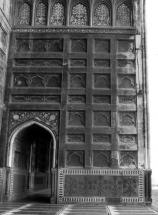
Mosque, west of mausoleum, east facade, iwan, north wall: The mosque has three domed bays which are of hall-like dimensions and made cruciform by arched recesses. All the dados have a display of flowering plants that recall their marble counterparts in the mausoleum; but since sandstone is more susceptible to corrosion, they are not as well preserved and have been replaced by carved copies. Flowers and plants were a form of decoration specially sanctioned by Islamic theologians and so were appropriate for a religious building.