Site Name: Agra
Date: 1631-1648 CE
Subject:
View of the Taj Mausoleum


 CENTER FOR ART AND ARCHAEOLOGY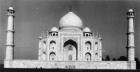
View of the Taj Mausoleum
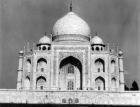
View of the Taj Mausoleum
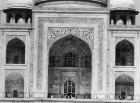
View of the Taj Mausoleum
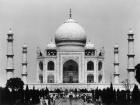
View of the Taj Mausoleum
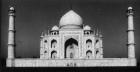
View of the Taj Mausoleum
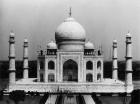
View of the Taj Mausoleum
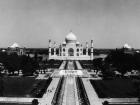
Taj Mausoleum and garden, general view from the top of main entrance: The garden is the heart of the Taj Mahal Complex. The large square is divided by two main walkways (khiyaban) into four quadrants. Each quadrant is further divided by narrower cross-axial walkways. The garden was supplied with water from the Yamuna river through an aqueduct. The original planting is a not a well known aspect of the garden. The present lawns, flowers and trees are maintained by the Horticultural Branch of the ASI.
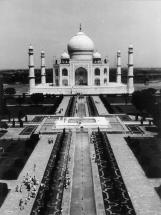
Taj Mausoleum and garden, general view from the top of main entrance: The garden is the heart of the Taj Mahal Complex. The large square is divided by two main walkways (khiyaban) into four quadrants. Each quadrant is further divided by narrower cross-axial walkways. The garden was supplied with water from the Yamuna river through an aqueduct. The original planting is a not a well known aspect of the garden. The present lawns, flowers and trees are maintained by the Horticultural Branch of the ASI.
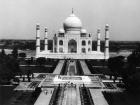
Taj Mausoleum and garden, general view from the top of main entrance: The garden is the heart of the Taj Mahal Complex. The large square is divided by two main walkways (khiyaban) into four quadrants. Each quadrant is further divided by narrower cross-axial walkways. The garden was supplied with water from the Yamuna river through an aqueduct. The original planting is a not a well known aspect of the garden. The present lawns, flowers and trees are maintained by the Horticultural Branch of the ASI.
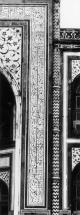
Main entrance on south to Taj Mausoleum, portal, west half: The great gate called darwaza-i rauza (gate of the mausoleum) is clad in red sandstone and white marble. White marble frames the dominant portal arch in the center and then decreases towards the corner towers. The corners are accentuated by engaged towers (minarets). At the bottom left end of the frame is the signature of the calligrapher Amanat Khan and Hijri date 1057 (1647/48 CE). The great gate doesn't have an outer dome.
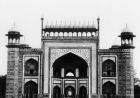
Main entrance on south to Taj Mausoleum compound, upper part: The great gate called darwaza-i rauza (gate of the mausoleum) is clad in red sandstone and white marble. White marble frames the dominant portal arch in the center and then decreases towards the corner towers. The corners are accentuated by engaged towers (minarets). At the bottom left end of the frame is the signature of the calligrapher Amanat Khan and Hijri date 1057 (1647/48 CE). The great gate doesn't have an outer dome.
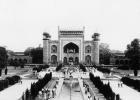
Main entrance on south to Taj Mausoleum compound, General view: The great gate called darwaza-i rauza (gate of the mausoleum) is clad in red sandstone and white marble. White marble frames the dominant portal arch in the center and then decreases towards the corner towers. The corners are accentuated by engaged towers (minarets). At the bottom left end of the frame is the signature of the calligrapher Amanat Khan and Hijri date 1057 (1647/48 CE). The great gate doesn't have an outer dome.
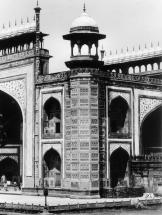
Main entrance on south to Taj Mausoleum compound, Southeast corner: The great gate called darwaza-i rauza (gate of the mausoleum) is clad in red sandstone and white marble. White marble frames the dominant portal arch in the center and then decreases towards the corner towers. The corners are accentuated by engaged towers (minarets). At the bottom left end of the frame is the signature of the calligrapher Amanat Khan and Hijri date 1057 (1647/48 CE). The great gate doesn't have an outer dome.
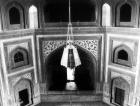
Main entrance on south to Taj Mausoleum compound, Interior: The bronze lamp was commissioned by Lord Curzon from the Mayo School of Art at Lahore that was installed in 1909 after being exhibited in England. The side rooms are used as offices of the ASI for the administration of the monument.
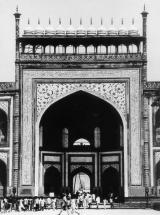
Main entrance on south to Taj Mausoleum compound, portal: The great gate called darwaza-i rauza (gate of the mausoleum) is clad in red sandstone and white marble. White marble frames the dominant portal arch in the center and then decreases towards the corner towers. The corners are accentuated by engaged towers (minarets). At the bottom left end of the frame is the signature of the calligrapher Amanat Khan and Hijri date 1057 (1647/48 CE). The great gate doesn't have an outer dome.
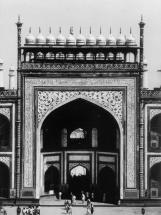
Main entrance on south to Taj Mausoleum compound, portal: The great gate called darwaza-i rauza (gate of the mausoleum) is clad in red sandstone and white marble. White marble frames the dominant portal arch in the center and then decreases towards the corner towers. The corners are accentuated by engaged towers (minarets). At the bottom left end of the frame is the signature of the calligrapher Amanat Khan and Hijri date 1057 (1647/48 CE). The great gate doesn't have an outer dome.
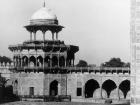
Octagonal Burj at southwest corner of Taj Mausoleum platform: At the four corners of the terrace, there are four octagonal towers (burj) of three storeys, and the third storey has a domed roof. While these are accents of the architectural composition, they also have a functional use.
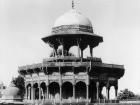
Octagonal pavilion at southwest corner of compound hall: At the four corners of the terrace, there are four octagonal towers (burj) of three storeys, and the third storey has a domed roof. While these are accents of the architectural composition, they also have a functional use.
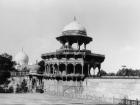
Octagonal pavilion at southwest corner of compound hall: At the four corners of the terrace, there are four octagonal towers (burj) of three storeys, and the third storey has a domed roof. While these are accents of the architectural composition, they also have a functional use.
Fatehpuri Darwaza, outer west gate: the gate has a broad center with a pishtaq taking the form of a pointed archway in a rectangular frame, set between engaged polygonal shafts topped by guldastas (ornamental pinnacles extending above roof level). At the top is a parapet carved in relief with crenelations.
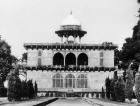
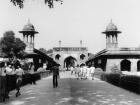
Garden, pavilion at western end of east-west water channel: There are two pavilions placed in mirror symmetry in the enclosing wall at the ends of the east-west walkway. The pavilions are known as Naubat Khana (drum house). It consists of an open veranda framed by square closed rooms.
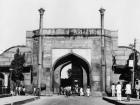
Fatehpuri Darwaza, outer west gate: the gate has a broad center with a pishtaq taking the form of a pointed archway in a rectangular frame, set between engaged polygonal shafts topped by guldastas (ornamental pinnacles extending above roof level). At the top is a parapet carved in relief with crenelations.
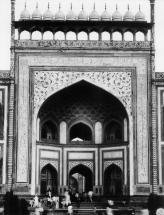
Main entrance on south to Taj Mausoleum compound, portal: The great gate called darwaza-i rauza (gate of the mausoleum) is clad in red sandstone and white marble. White marble frames the dominant portal arch in the center and then decreases towards the corner towers. The corners are accentuated by engaged towers (minarets). At the bottom left end of the frame is the signature of the calligrapher Amanat Khan and Hijri date 1057 (1647/48 CE). The great gate doesn't have an outer dome.