Site Name: Agra
Date: 1631-1648 CE
Subject:
View of the Taj Mausoleum


 CENTER FOR ART AND ARCHAEOLOGY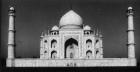
View of the Taj Mausoleum
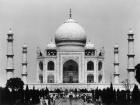
View of the Taj Mausoleum
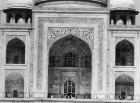
View of the Taj Mausoleum
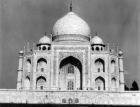
View of the Taj Mausoleum
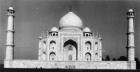
View of the Taj Mausoleum
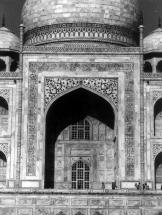
Taj Mausoleum, Eastern face, central part: The pishtaq is accentuated by a large inscription in sulus script in a band on its rectangular frame. The texts are selected passages from the Quran which relate to the eschatological programme of the building with references to the Last Judgment, divine forgiveness, and the reward of the faithful in Paradise. The spandrels are filled with flowery arabesques in red, green and dark yellow in inlay. The inner walls of the iwan are patterned with blind arches alternating with cartouches.
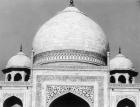
Taj Mausoleum, Eastern face, detail: The terrace is dominated by the outer dome, which rises with its high drum like an independent tower in the center. The dome has bulbous profile with a crowning element formed of lotus leaves and from this rises a kalash (finial). The dome is surrounded by four chhatris. The arcades of the chhatris consist of multi-cusped arches.
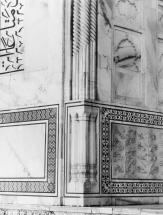
Taj Mausoleum, West face, detail: Engaged bundled colonnettes and rope mouldings framing the pishtaq. Delicate relief carvings of plant elements is reserved for the lowest zone of the building where it could be immediately appreciated by the viewer. Each pishtaq is accentuated by a large inscription in sulus script in a band on its rectangular frame.
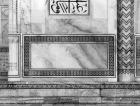
West face, detail: The top of the plinth is accentuated by a moulding showing a row of hanging leaves (dasa). At the bottom is a related pattern, with rows of hanging flowers and buds. In between is a band of interlacing cartouches with mirror-symmetrical acanthus leaves.
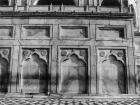
Plinth, detail: The platform is set off from the paved surface of the terrace by paving with an interlocking pattern of white marble octagons into which are set four-pointed sandstone stars surrounded by a border with alternating long and short cartouches. The marble facing consists of a row of rectangular panels into which are set trefoil-headed blind arches topped by a leaf, with medallions in the spandrels showing an interlacing leafy pattern.
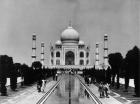
Taj Mausoleum, general view
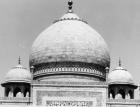
Taj Mausoleum, Southern facade, upper part: The terrace is dominated by the outer dome, which rises with its high drum like an independent tower in the center. The dome has bulbous profile with a crowning element formed of lotus leaves and from this rises a kalash (finial). The dome is surrounded by four chhatris. The arcades of the chhatris consist of multi-cusped arches.
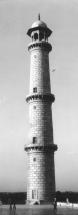
Taj Mausoleum, Northeast tower: The towers (minarets) surrounding the tomb have a tapering cylindrical shaft set on an octagonal base, encircled by three balconies, and topped by chhatri with a kalasha finial. The exterior is formed of curved marble blocks, the joints of which are lined with black stone intarsia creating rustication effect. The towers lean outward, which serves both form and function: in addition to providing aesthetic balance, the pillars would crumble away from the main crypt in a disaster like an earthquake.
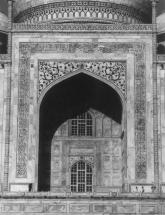
Taj Mahal complex, Taj mausoleum, Iwan on east: The pishtaq is accentuated by a large inscription in sulus script in a band on its rectangular frame. The texts are selected passages from the Quran which relate to the eschatological programme of the building with references to the Last Judgment, divine forgiveness, and the reward of the faithful in Paradise. The spandrels are filled with flowery arabesques in red, green and dark yellow in inlay. The inner walls of the iwan are patterned with blind arches alternating with cartouches.
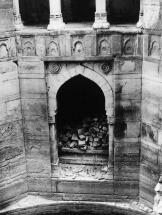
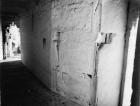
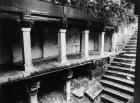
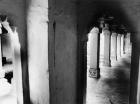
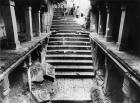
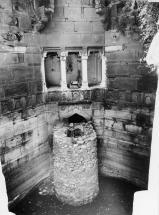
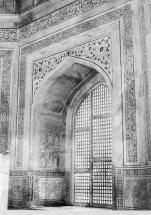
Taj Mausoleum, Octagonal mortuary hall, interior, wall detail. The hall has the form of a perfect octagon to a side, with two tiers of two radiating niches. The niches are framed, and the room encircled, by inlaid inscriptions from the Quran. The dados display carved flower vases framed by pietra dura inlay, and corner colonnettes are carved with plant motifs springing from pots with overhanging leaves - evoking paradisical bloom.
Taj Mausoleum, Octagonal mortuary hall, interior, wall detail: The hall has the form of a perfect octagon to a side, with two tiers of two radiating niches. The niches are framed, and the room encircled, by inlaid inscriptions from the Quran. The dados display carved flower vases framed by pietra dura inlay, and corner colonnettes are carved with plant motifs springing from pots with overhanging leaves - evoking paradisical bloom.
Taj Mausoleum, Octagonal mortuary hall, interior, wall detail. The hall has the form of a perfect octagon to a side, with two tiers of two radiating niches. The niches are framed, and the room encircled, by inlaid inscriptions from the Quran. The dados display carved flower vases framed by pietra dura inlay, and corner colonnettes are carved with plant motifs springing from pots with overhanging leaves - evoking paradisical bloom.