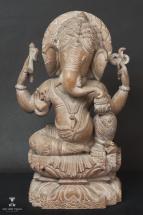
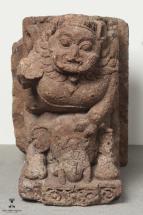
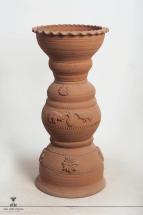
Subject: Ganesha. Ganesha is the elephant-headed god who is the son of Lord Shiva and Goddess Parvati. This object has been procured from State Institute for Development of Arts & Crafts (SIDAC) Show House Museum, Handicrafts Complex.
Site Name:
Date: ca 1000-1099 CE
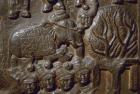
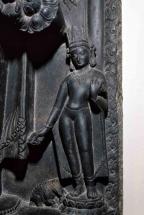
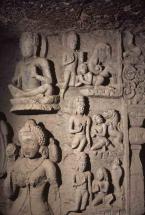
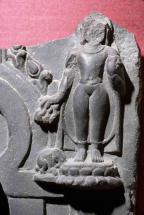
Subject: Lower right portion, The Nalagiri elephant; Standing Crowned Buddha
Site Name: Sanchi
Date: ca 199-100 BCE
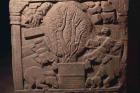
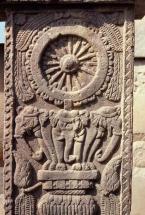
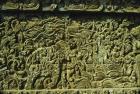
Subject: Stupa 2, Balustrade, southwest sector: inner face of pillar 66B: cakra supported by elephants
Site Name: Bharhut
Date: ca 100 BCE
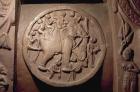
Subject: Section: Medallion with monkeys riding on an elephant; Stupa Vedika (Railing)
Site Name: Bhubaneswar
Date: 1900-1999
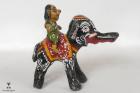
Subject: Man on Elephant. A figure of a man on an elephant, made in cow dung. Cow dung, over centuries, has been used for making toys as an inexpensive alternative to wooden and metal toys. A lump of mixture of clay and cow dung is shaped and smoothened with a coat of chalk and then painted. These lightweight toys are generally coarse in design and lack detailing and ornamentation. This object has been loaned by State Institute for Development of Arts & Crafts (SIDAC).
Site Name: Jago
Date: ca 1250-1299 CE
Subject: Parthayajna Legend: elephant; Funerary monument for Visnuvardhana (d. 1268), built by his son Krtanagara. Reliefs date from later period, perhaps 14th century.
Site Name: Borivli National Park, Kanheri
Date: ca 500 CE
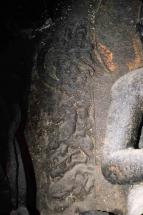
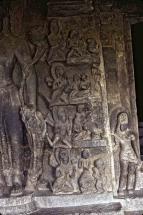
Subject: Main Hall, Right rear wall, Litany of Avalokitesvara, right portion: From top to bottom, Avalokitesvara protects a person menaced by an elephant, by a lion, and by a snake
Site Name: Nasik
Date: ca 500-599 CE
Subject: Main Hall, Shrine, Left side of throne of Pralambapadasana Buddha: Elephant, lion and makara motif; Hinayana caves with Mahayana intrusions
Site Name: Baliguda
Date: 1900-1999
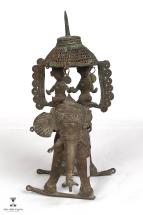
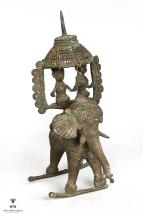
Subject: Goddess Mangala on Elephant. Dhokra craft items such as this that represent Goddess Mangala are associated with ritualistic and ceremonial uses in tribal communities. Goddess Mangala is the local goddess in Odisha who is a form of Durga. She is worshipped by the Kondh community during Dharani Penu (Earth Goddess) pooja ceremony. Dhokra is a craft made by the lost-wax casting technique in which a molten metal is poured into a mold that has been created by means of a wax model. Dhokra objects also represent tribal lineage, form part of a bride's dowry, represent everyday life and are collected as curios.
Site Name: Bhubaneswar
Date: 1900-1999
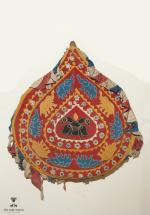
Subject: Trasha (Banner). This trasha is a heart-shaped wooden piece covered by appliqué with birds, elephants and flowers motifs and glass pieces. It is associated with the procession for deities and kings to show respect. Appliqué is an art of cutting and stitching stylized and bold cloth designs onto a piece of base cloth which could be mounted on a frame. Appliqué items such as this trasha are used for ritualistic practices as well as for decorative and utilitarian needs. This object has been loaned by State Institute for Development of Arts & Crafts (SIDAC) Show House.
Site Name: Bhubaneswar
Date: 1900-1999
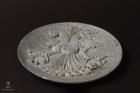
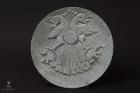
Subject: Decorative Plate. A decorative and utilitarian stone plate with a pair of elephants and a pair pf peacocks in high relief. Odisha’s most recognized craft is stone carving. Odisha’s maharanas (stone carvers) sculpt in stones with simple tools by first outlining the figure on a stone block. The outline is incised to mark the shape of the motif and then the figure is carved. Stone carved sculptures are made for iconic sculptures from Odisha’s temples and idols of Hindu deities. This is an in-house artefact of the State Institute for Development of Arts & Crafts (SIDAC) Show House.
Site Name: Bhubaneswar
Date: 1900-1999
Subject: Decorative Plate. A decorative and utilitarian stone plate with a pair of elephants and a pair pf peacocks in high relief. Odisha’s most recognized craft is stone carving. Odisha’s maharanas (stone carvers) sculpt in stones with simple tools by first outlining the figure on a stone block. The outline is incised to mark the shape of the motif and then the figure is carved. Stone carved sculptures are made for iconic sculptures from Odisha’s temples and idols of Hindu deities. This is an in-house artefact of the State Institute for Development of Arts & Crafts (SIDAC) Show House.
Site Name: Bhubaneswar
Date: 900-999
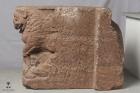
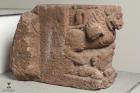
Subject: Architectural Fragment. Gajasimha is a mythical hybrid animal or Vyala in Hindu mythology, appearing as a lion with the head or trunk of an elephant. Side view of the fragment. This object has been loaned by the Odisha State Museum.
Site Name: Bhubaneswar
Date: 900-999
Subject: Architectural Fragment. Gajasimha is a mythical hybrid animal or Vyala in Hindu mythology, appearing as a lion with the head or trunk of an elephant. Side view of the fragment. This object has been loaned by the Odisha State Museum.
Site Name: Bhubaneswar
Date: 900-999
Subject: Architectural Fragment. Gajasimha is a mythical hybrid animal or Vyala in Hindu mythology, appearing as a lion with the head or trunk of an elephant. This object has been loaned by the Odisha State Museum.
Site Name: Aurangabad
Date: ca 550 - 600 CE
Subject: Entrance to Ambulatory, Left side, Litany of Avalokitesvara, right portion: Figures menaced by a lion, snakes and elephant
Site Name:
Date: ca 900-1099 CE
Subject: Upper right: The Nalagiri Elephant; Crowned Buddha
Site Name: Balikandal
Date: 1800-1899
Subject: Tulasi Brundavati Chaura. In Odisha, goddess Brundavati is worshipped in the form of Chaura, which is a small temple like structure adorned with sculptures and with a Tulasi plant overhead. Tulasi Chaura is mostly worshipped by married women who want blessings for leading a prosperous family life. View of elephants flanking purna-ghata.
Site Name: Udaipur
Date: 1710-1734 CE
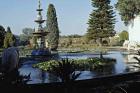
Subject: Basin with tiered fountain and elephants; Built under Sangram Singh II (r. 1710-1734)
Site Name:
Date: 1900-1999
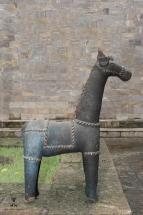
Subject: Votive Horse. The offering of votive horses and elephants to the village deities is a common phenomenon of rural Odisha. Such sculptures are made as offerings to a deity and left untended where they are placed, under a tree, near a pond or river, or in a grove. They accumulate, they decompose, and others take their place. The seven pieces of the horse are made separately on the wheel and then joined together adding the molded ears and tail.
Site Name: Baliguda
Date: 1900-1999
Subject: Goddess Mangala on Elephant. Dhokra craft items such as this that represent Goddess Mangala are associated with ritualistic and ceremonial uses in tribal communities. Goddess Mangala is the local goddess in Odisha who is a form of Durga. She is worshipped by the Kondh community during Dharani Penu (Earth Goddess) pooja ceremony. Dhokra is a craft made by the lost-wax casting technique in which a molten metal is poured into a mold that has been created by means of a wax model. Dhokra objects also represent tribal lineage, form part of a bride's dowry, represent everyday life and are collected as curios.