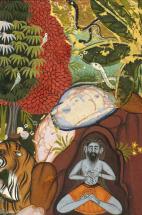
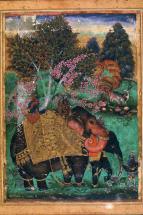
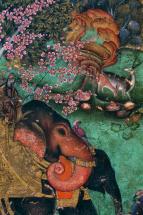
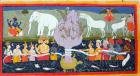
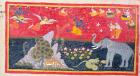
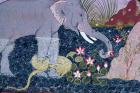
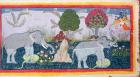
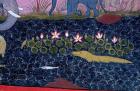
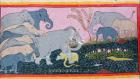
Subject: Lower right portion, Ascetic in cave [Redemption of the King of Elephants, Gajendramoksha series: the Trikuta scene]
Site Name: Udaipur
Date: 1648 CE
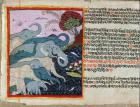
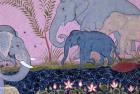
Subject: Gajendra and his herd entering the lake in Ritumat (Rtumat) Garden; Gajendra Moksham. The episode of Vishnu saving the king of elephants (Gajendra) from the jaws of the crocodile. [Gajendra Moksham (Liberation of Gajendra, the King of the Elephants)]
Site Name:
Date: ca 1565-80 CE
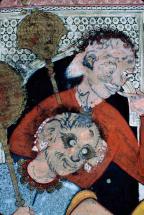
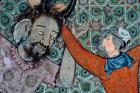
Subject: Hamza kills the leader of the elephant-eared creatures
Site Name:
Date: ca 1590-1595 CE
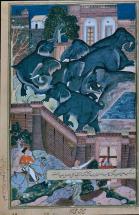
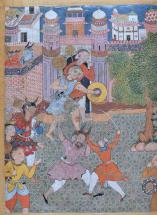
Subject: Wild elephants captured by Akbar and put into the fort at Bayanwan; The Akbarnama was commissioned by the emperor Akbar as the official chronicle of his reign. It was written by his court historian and biographer Abu'l Fazl between 1590 and 1596 and is thought to have been illustrated between about 1592 and 1594 by at least 49 different artists from Akbar's studio.
Site Name:
Date: ca 1610 CE
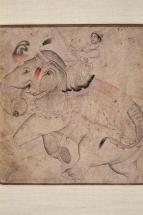
Subject: Burhan al Mulk's Running Elephant
Site Name: Bijapur/Vijayapur
Date: ca 1595-1600 CE
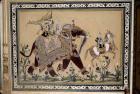
Subject: Ibrahim Adil Shah Riding an Elephant
Site Name: Bijapur/Vijayapur
Date: ca 1595-1600 CE
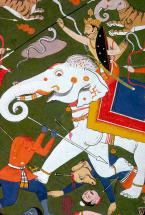
Subject: Elephants, Ibrahim Adil Shah Riding an Elephant
Site Name: Calcutta
Date: 1952 CE
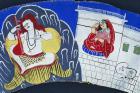
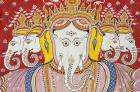
Subject: Siva and his Family; Siva's consort is Parvati. Ganesh (Ganesha), the elephant-headed god, is the son of Parvati.
Site Name:
Date: ca 1565-80 CE
Subject: Hamza kills the leader of the elephant-eared creatures
Site Name:
Date: ca 1565-80 CE
Subject: Hamza kills the leader of the elephant-eared creatures
Site Name: Udaipur
Date: 1648 CE
Subject: Folio 37, Fight of the disappointed Asuras: Indra mounted on Airavata (the white elephant); Kurma Avatara (Tortoise incarnation) of Vishnu. The episode of churning the ocean of milk for nectar. [Kurma Avatara (Incarnation as a Tortoise)]
Site Name: Udaipur
Date: 1648 CE
Subject: The oceans yielding the divine cow, Surabhi; the Apsaras; the white horse, Uccaihsravas; the white elephant, Airavata; the Parijata tree, and Laksmi; Kurma Avatara (Tortoise incarnation) of Vishnu. The episode of churning the ocean of milk for nectar. [Kurma Avatara (Incarnation as a Tortoise)]
Site Name:
Date: ca 1860 CE
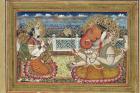
Subject: Worship of Ganesha; Ganesh (Ganesha), the elephant-headed god, is the son of Parvati.
Site Name: Udaipur
Date: 1648 CE
Subject: Folio 11, Visnu frees Gajendra from crocodile; Gajendra Moksham. The episode of Vishnu saving the king of elephants (Gajendra) from the jaws of the crocodile. [Gajendra Moksham (Liberation of Gajendra, the King of the Elephants)]
Site Name: Udaipur
Date: 1648 CE
Subject: Folio 6b, Gajendra praying to Visnu; Gajendra Moksham. The episode of Vishnu saving the king of elephants (Gajendra) from the jaws of the crocodile. [Gajendra Moksham (Liberation of Gajendra, the King of the Elephants)]
Site Name:
Date: 1952 CE
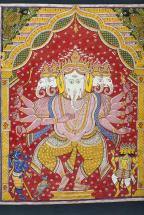
Subject: Ganesh (Ganesha), the elephant-headed god, is the son of Parvati.
Site Name: Udaipur
Date: 1648 CE
Subject: Folio 6b, Gajendra praying to Visnu; Gajendra Moksham. The episode of Vishnu saving the king of elephants (Gajendra) from the jaws of the crocodile. [Gajendra Moksham (Liberation of Gajendra, the King of the Elephants)]
Site Name: Udaipur
Date: 1648 CE
Subject: Folio 6a, Gajendra seized by the crocodile: crocodile in lake; Gajendra Moksham. The episode of Vishnu saving the king of elephants (Gajendra) from the jaws of the crocodile. [Gajendra Moksham (Liberation of Gajendra, the King of the Elephants)]
Site Name: Udaipur
Date: 1648 CE
Subject: Folio 6a, Gajendra seized by the crocodile: baby elephants; Gajendra Moksham. The episode of Vishnu saving the king of elephants (Gajendra) from the jaws of the crocodile. [Gajendra Moksham (Liberation of Gajendra, the King of the Elephants)]
Site Name: Udaipur
Date: 1648 CE
Subject: Folio 6a, Gajendra seized by the crocodile; Gajendra Moksham. The episode of Vishnu saving the king of elephants (Gajendra) from the jaws of the crocodile. [Gajendra Moksham (Liberation of Gajendra, the King of the Elephants)]
Site Name: Jaipur (Amber)
Date: ca 1592-1800 CE
Subject: Construction began under Raja Man Singh I, Akbar's army commander, and was completed by Mirza Raja Jai Singh and Sawai Jai Singh over a period of about two centuries; Unlocated panel: Elephant
Site Name:
Date: 1952 CE
Subject: Ganesh (Ganesha), the elephant-headed god, is the son of Parvati.
Site Name: Jaipur
Date: ca 1900 CE
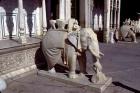
Subject: Rajendra Pol (Gateway of Princes or Emperor's Gate), built under Madho Singh II (r. 1880-1922); Marble elephants at entrance, from southwest
Site Name: Bundi
Date: ca 1800 CE
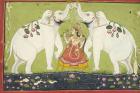
Subject: Gaja Lakshmi; The scene depicts the goddess Lakshmi, a symbol of prosperity, being lustrated by two elephants who represent the rain clouds that bring water and life to the land.