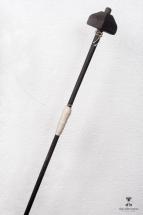
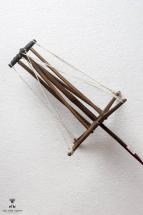
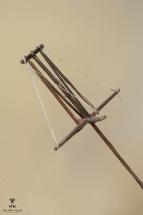
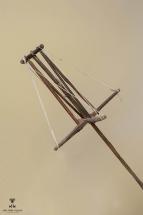
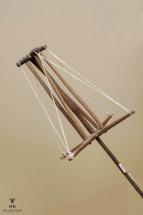
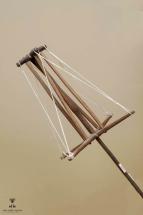
Subject: Tasara. Tasara is a tool that is used for manual spinning of tussar yarn.
Site Name: Nuapatna
Date: 1997
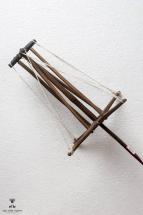
Subject: Frame for Tie separation. A frame is used for separating individual ikat threads for making motifs with partly tied ikat resists. This object was procured from Nuapatna No 2 Weavers Cooperative Society Ltd.
Site Name: Tigria
Date:
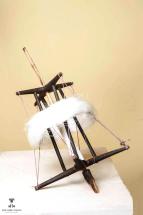
Subject: Nata (Natei). Nata or natei is a conical frame used for winding yarn. Winding is a process where yarn is transferred to a more portable form (cone, spool, pirn). Yarn from a smaller package like bobbin or hank is transferred to a larger package of considerably longer length. This also helps in improving the quality of yarn by removing unnecessary small knots and dust particles. This object was procured from Nuapatna No 2 Weavers Cooperative Society Ltd.
Site Name: Gopalpur
Date: 1900-1999
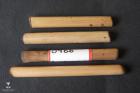
Subject: Plastic Pirn - Part of Nata (0482). A pirn is a rod onto which weft thread is wound for use in weaving. This object was procured from Nuapatna No 2 Weavers Cooperative Society Ltd.
Site Name:
Date:
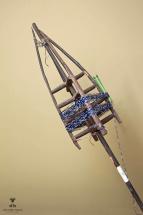
Subject: Nata with nylon thread. Nata or natei is a conical frame used for winding yarn. Winding is a process where yarn is transferred to a more portable form (cone, spool, pirn). Yarn from a smaller package like bobbin or hank is transferred to a larger package of considerably longer length. This also helps in improving the quality of yarn by removing unnecessary small knots and dust particles.
Site Name: Nuapatna
Date: 1917
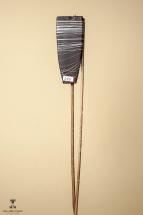
Subject: Heald Maker (Boupati). Heald maker is a tool used for the separating the weft thread on weaving looms. This object was procured from Nuapatna No 2 Weavers Cooperative Society Ltd.
Site Name: Nuapatna
Date: 1967
Subject: Double Chadiki (Small Size with white thread). Dual chadkis are used for plying threads for any type of preparatory work for weaving of cloth. This object was procured from Nuapatna No 2 Weavers Cooperative Society Ltd.
Site Name: Nuapatna
Date:
Subject: Double Chadiki (Small Size with white thread). A chadiki is used to accommodate small hanks prepared from big hanks or tie and dye materials. This object was procured from Nuapatna No 2 Weavers Cooperative Society Ltd.
Site Name: Nuapatna
Date: 1967
Subject: Double Chadiki (Small Size with white thread). Dual chadkis are used for plying threads for any type of preparatory work for weaving of cloth. This object was procured from Nuapatna No 2 Weavers Cooperative Society Ltd.
Site Name: Nuapatna
Date:
Subject: Double Chadiki (Small Size with white thread). A chadiki is used to accommodate small hanks prepared from big hanks or tie and dye materials. This object was procured from Nuapatna No 2 Weavers Cooperative Society Ltd.
Site Name: Nuapatna
Date: 1967
Subject: Double Chadiki (Small Size with white thread). Dual chadkis are used for plying threads for any type of preparatory work for weaving of cloth. This object was procured from Nuapatna No 2 Weavers Cooperative Society Ltd.
Site Name: Nuapatna
Date:
Subject: Double Chadiki (Small Size with white thread). A chadiki is used to accommodate small hanks prepared from big hanks or tie and dye materials. This object was procured from Nuapatna No 2 Weavers Cooperative Society Ltd.
Site Name: Tigria
Date: 1977
Subject: Nata (Natei). Nata or natei is a conical frame used for winding yarn. Winding is a process where yarn is transferred to a more portable form (cone, spool, pirn). Yarn from a smaller package like bobbin or hank is transferred to a larger package of considerably longer length. This also helps in improving the quality of yarn by removing unnecessary small knots and dust particles.
Site Name: Agalpur
Date: 1936
Subject: Hatha Manga. Hatha Manga or the sley is the skeleton frame of a loom. It holds the entire structure of a loom including the cloth beam, shafts, reed, warp beam and weaver’s bench according to the type of loom. This object was procured from Salebhata village.
Site Name: Nuapatna
Date: 1977
Subject: Pirn. A pirn is a rod onto which weft thread is wound for use in weaving. It is locally called Nali and is now obsolete and wooden and plastic pirns are used.
Site Name: Athagarh
Date: 2016
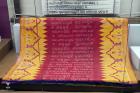
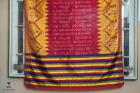
Subject: Gita Gobinda Silk Tied Dhadi. This is a traditional bandha or ikat saree from Odisha that is used to decorate Lord Jagannatha or worn by women on special occasions. The saree contains texts from Jayadeva’s Gita Gobinda on it.
Site Name: Bhubaneswar
Date:
Subject: Frame for Gita Gobinda Dhadi. This is a traditional bandha or ikat saree from Odisha on a wooden frame. The saree contains texts from Jayadeva’s Gita Gobinda on it.
Site Name:
Date:
Subject: Gita Govinda Silk Fabric (Badasingharbesa Bastra). This is a traditional bandha or ikat saree from Odisha and a special type of which is offered to Jagannatha to wear as khandua with stanzas and illustration from Gita Gobinda.
Site Name:
Date:
Subject: Gita Govinda Silk Fabric (Badasingharbesa Bastra). This is a traditional bandha or ikat saree from Odisha and a special type of which is offered to Jagannatha to wear as khandua with stanzas and illustration from Gita Gobinda.
Site Name: Bhubaneswar
Date:
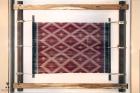
Subject: Weft Tie-Dyed in Taraballi Design with Frame. Warp and weft are the two basic components used in weaving to turn thread or yarn into fabric. The lengthwise or longitudinal warp yarns are held stationary in tension on a frame or loom while the transverse weft is drawn through and inserted over-and-under the warp. Taraballi is amongst the oldest khandua or ikat designs of Odisha that is basically a star-studded weave. This object has been procured from Boyanika (Odisha State Handloom Weavers Cooperative Society Ltd).
Site Name: Bhubaneswar
Date:
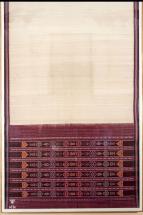
Subject: Eri Silk Bandha sari. Eri silk comes from the caterpillar of Samia ricini. The eri silkworm is a completely domesticated silkworm. Eri Cocoons are open mouthed since the moth leaves the cocoon as soon as it is ready to be spun. Bandha sari is tie-dye sari wherein the warp and the weft are tie-dyed before weaving. This object has been procured from Boyanika (Odisha State Handloom Weavers Cooperative Society Ltd).
Site Name:
Date:
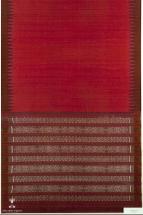
Subject: Tussar Phodakumbha sari. Tussar silk is extracted from silkworms feeding on local trees like Sal, Arjun and Saja. Odisha is one of the major Indian states that produces silk. The phodakumbha saris have a interlocked temple spire design (phoda kumbha) border. This object was procured from Hingula Weaver Co-operative Society Ltd.
Site Name: Nuapatna
Date: 1917
Subject: Slay (Palm tree). Slay is the part of loom that carries the reed and oscillates between the harness and the fell of the cloth.
Site Name: Khuntapali
Date: 1925
Subject: Hatha Manga. Hatha Manga or the sley is the skeleton frame of a loom. It holds the entire structure of a loom including the cloth beam, shafts, reed, warp beam and weaver’s bench according to the type of loom.