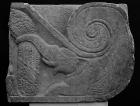
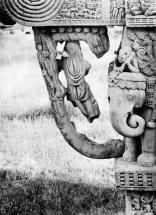
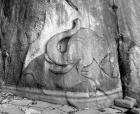
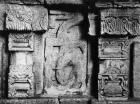
Subject: Torana architrave fragment showing garland bearing elephant and voluted end, detail
Site Name:
Date: ca 1610 CE
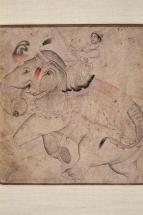
Subject: Burhan al Mulk's Running Elephant
Site Name:
Date: 851-856 CE
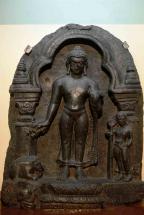
Subject: Buddha and Nalagiri, the Mad Elephant
Site Name: Borivli National Park, Kanheri
Date: ca 500 CE
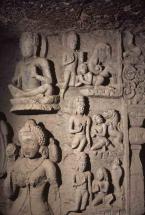
Subject: Main Hall, Right rear wall, Litany of Avalokitesvara, right portion: From top to bottom, Avalokitesvara protects a person menaced by an elephant, by a lion, and by a snake
Site Name: Bhubaneswar
Date: 1990-1999
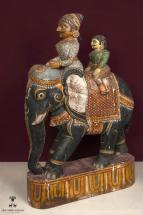
Subject: Two men on an elephant. This object shows two men on an elephant painted and carved in wood. An essential part of growing up in Odisha is toys, dolls, puppets and masks from wood. These toys are richly colored and developed in a stylized form. Often, gambhari or beech wood, the local wood is used for the carvings as it has a fine texture and is light-cream color though other woods may also be used. This object has been procured by State Institute for Development of Arts & Crafts (SIDAC) Show House.
Site Name: Kausambi
Date: ca 300-699 CE
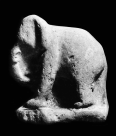
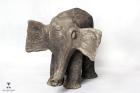
Subject: Model of an elephant
Site Name: Sanchi
Date: 99-1 BCE
Subject: Back view west side, detail showing yaksi and elephant rider
Site Name: Bhubaneswar
Date: 1901-2000
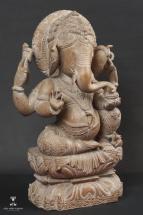
Subject: Ganesha. Ganesha is the elephant-headed god who is the son of Lord Shiva and Goddess Parvati. Back view of the sculpture. This object has been procured from State Institute for Development of Arts & Crafts (SIDAC) Show House Museum, Handicrafts Complex.
Site Name:
Date: 1990-1999
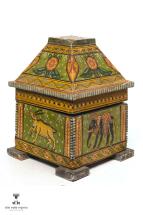
Subject: Dowry Box. Pedis, or dowry boxes are created by chitrakaras and are used to store items of dowries. These are wooden boxes often made of gamharia wood which are covered with cloth canvas and painted over. The boxes may be decorated with scenes from the life of Krishna or they may be decorated with images of musicians and dancers, animals, plants, or other designs. Side view of the box - one side shows a deer and the other side shows an elephant.
Site Name: Bhubaneswar
Date: 1800-1899
Subject: Elephant Deepa. This is a vertically oriented lamp that is lit during rituals and prayers dedicated to deities. It has an elephant figure at the base. This object has been loaned by State Institute for Development of Arts & Crafts (SIDAC) Show House.
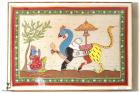
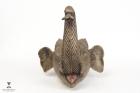
Subject: Nabgunjara Wall Hanging. This wall hanging shows the mythical creature Nabgunjara that is a composite animal in which Lord Vishnu disguised himself in the Odia version of Mahabharata. It has the head of a cock, neck of a peacock, hump of the bull, a snake for tail, and the waist of a lion. Three of its legs are from a tiger, a horse and an elephant while the fourth is a human holding a flower or a mirror. Such appliqué wall hangings are used for good luck. Appliqué is an art of cutting and stitching stylized and bold cloth designs onto a piece of base cloth which could be mounted on a frame. Appliqué items are used for ritualistic practices as well as for decorative and utilitarian needs. This object has been loaned by State Institute for Development of Arts & Crafts (SIDAC) Show House.
Site Name:
Date:
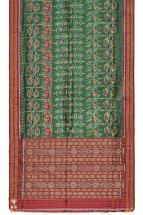
Subject: Special Khandua Design Bandha Saree (Green). Khandua is a traditional ikat (tie and dye or bandha) saree from Odisha that is worn during auspicious ceremonies. The body of the saree has rows of elephant, large flower and tendril pattern. The color scheme of the saree is red and green. This object was procured from Nuapatna No 1 Weavers Cooperative Society Ltd.
Site Name: Sarnath
Date: 299-200 BCE
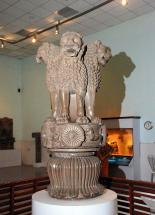
Subject: Lion capital. The capital shows four addorsed lions mounted on a round abacus. On the abacus are four animals-a bull, a lion, an elephant, and a galloping horse–separated from one another by a wheel, a reference to the Buddha’s turning of the Wheel of the Law. A large stone wheel’s rim is supported on the backs of the four addorsed lions. The wheels are also a symbol of the ideal universal monarch, the chakravartin used by Ashoka, who sought to project himself as a chakravartin.
Subject: Elephant Palanki Head. This elephant head was most probably the finial for an elaborately decorated palanquin.
Site Name: Sanchi
Date: 199-100 BCE
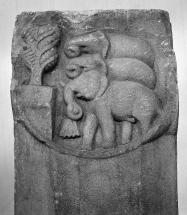
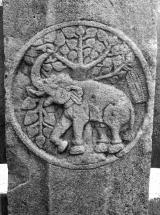
Subject: Vedika, southeast quadrant, inner face, pillar, detail, central medallion, elephant plucking a branch of tree
Site Name: Nalanda
Date: ca 600-699 CE
Subject: East face, elephant sporting with lotuses
Site Name:
Date: 1800-1899
Subject: Elephant. Odisha is known for its lineage of skilled artisans of terracotta pottery. Terracotta crafts being water and weather proof are popular as indoor objects as well as outdoor decoration. Products range from those belonging to ritualistic ceremonies to artifacts of utilitarian and artistic significance. Animal figurines such as this elephant are also popular. Front view of elephant.
Site Name: Ellora
Date: ca 810-880 CE
Subject: Court entrance, Elephant to right
Site Name: Bahali
Date: 1800-1899
Subject: Hathi (Elephant). An elephant made of paddy. Paddy craft uses un-husked rice or paddy which is strung together using cotton thread to create chains, idols of deities, animal figures, garlands and floral arrangements and other votives.
Site Name: Mahabalipuram
Date: ca 600-699 CE
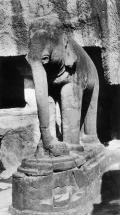
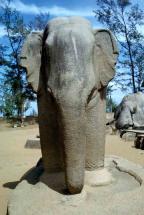
Subject: Monolithic Elephant, from south; Sculpture in situ