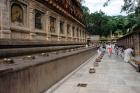
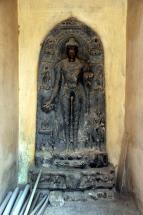
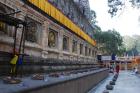
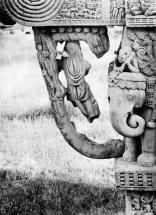
Site Name: Sanchi
Date: 199-100 BCE
Subject: Vedika, northeast quadrant, outer face, pillar, detail, central medallion, elephant with riders


 CENTER FOR ART AND ARCHAEOLOGY


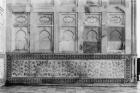
Taj Mausoleum, Iwan on west, south wall, detail: The mausoleum sits on a plinth, decorated with delicate relief carvings (munabbat kari) of plant elements. Flowers cover the dados of the three walls of the iwan and have symmetrical composition and minute botanical details. Shah Jahan’s artists composed flowers of their own convention, even grafting blossoms and leaves of different species together onto one plant. The style of the representation of the carved dado flowers is inspired by European herbals of the 16th and 17th centuries which Jahangir’s painters had consulted for floral miniatures.
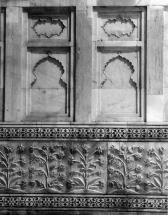
Taj Mausoleum, Iwan on west, carved and inlaid dado on side wall: The mausoleum sits on a plinth, decorated with delicate relief carvings (munabbat kari) of plant elements. Flowers cover the dados of the three walls of the iwan and have symmetrical composition and minute botanical details. Shah Jahan’s artists composed flowers of their own convention, even grafting blossoms and leaves of different species together onto one plant. The style of the representation of the carved dado flowers is inspired by European herbals of the 16th and 17th centuries which Jahangir’s painters had consulted for floral miniatures.
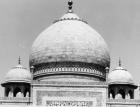
Taj Mausoleum, Southern facade, upper part: The terrace is dominated by the outer dome, which rises with its high drum like an independent tower in the center. The dome has bulbous profile with a crowning element formed of lotus leaves and from this rises a kalash (finial). The dome is surrounded by four chhatris. The arcades of the chhatris consist of multi-cusped arches.
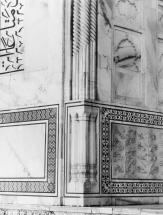
Taj Mausoleum, West face, detail: Engaged bundled colonnettes and rope mouldings framing the pishtaq. Delicate relief carvings of plant elements is reserved for the lowest zone of the building where it could be immediately appreciated by the viewer. Each pishtaq is accentuated by a large inscription in sulus script in a band on its rectangular frame.
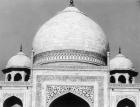
Taj Mausoleum, Eastern face, detail: The terrace is dominated by the outer dome, which rises with its high drum like an independent tower in the center. The dome has bulbous profile with a crowning element formed of lotus leaves and from this rises a kalash (finial). The dome is surrounded by four chhatris. The arcades of the chhatris consist of multi-cusped arches.
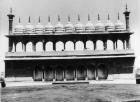
Main entrance on south to south Taj Mausoleum compound, superstructure, northern face: The roof of the great gate is accentuated with small white marble cupolas; the north and south pishtaqs are each topped by a row of eleven cupolas (chaukhandi) set between the freestanding guldastas of the engaged colonettes that frame the central part of the facades.
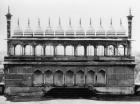
Main entrance on south to Taj Mausoleum compound, superstructure, southern face: The roof of the great gate is accentuated with small white marble cupolas; the north and south pishtaqs are each topped by a row of eleven cupolas (chaukhandi) set between the freestanding guldastas of the engaged colonettes that frame the central part of the facades.
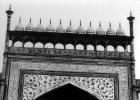
Main entrance on south to Taj Mausoleum compound, portal, upper part: The roof of the great gate is accentuated with small white marble cupolas; the north and south pishtaqs are each topped by a row of eleven cupolas (chaukhandi) set between the freestanding guldastas of the engaged colonettes that frame the central part of the facades.