Subject: South portal, left side, showing perforated screen in sandstone
Site Name: Delhi
Date: 1565 CE
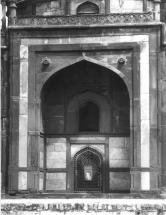
Subject: South portal, Upper storey, arched alcove, showing perforated screen in the arch and parapet
Site Name: Delhi
Date: 1565 CE
Subject: South portal, southwest corner screen
Site Name: Delhi
Date: 1565 CE
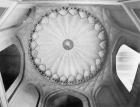
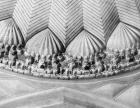
Subject: South portal, Lotus shaped domed ceiling with chevron pattern painted in white and central medallion in blue
Site Name: Delhi
Date: 1565 CE
Subject: South portal, Lotus shaped domed ceiling with chevron pattern painted in white and central medallion in blue
Site Name: Delhi
Date: 1565 CE
Subject: South portal, Lotus shaped domed ceiling with chevron pattern painted in white and central medallion in blue
Site Name: Delhi
Date: 1565 CE
Subject: South portal, Right wall inlaid with circle and star pattern in marble
Site Name: Delhi
Date: 1565 CE
Subject: South portal, Floor inlaid with stars in marble
Site Name: Delhi
Date: 1565 CE
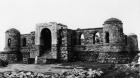
Subject: Two storied south portal in sandstone and borders blended in white marble
Site Name: Delhi
Date: 1565 CE
Subject: South portal, left spandrel showing lotus medallion and hexagram blended in white and black marble
Site Name: Delhi
Date: 1565 CE
Subject: North side, upper storey, showing arched alcove with perforated screen on parapet and decorative squinches
Site Name: Delhi
Date: 1565 CE
Subject: North side, upper storey, showing three arched alcoves and decorative squinches
Site Name: Delhi
Date: 1565 CE
Subject: Interior, north side, lowe three arched lobbies - their openings closed with perforated screens
Site Name: Delhi
Date: 1500-1599 CE
Subject: A view of an octagonal tomb with high recessed arch surmounted by high drum double dome covered ith colored tiles
Site Name: Delhi
Date: 1590-1591 CE, AH 999
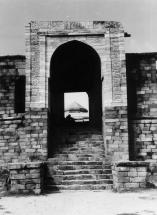
Subject: Arched portal, view
Site Name: Delhi
Date: 1231 CE
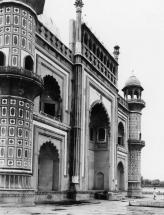
Subject: East side portal raised on a high plinth with circular bastions projecting from each angle
Site Name: Delhi
Date: 1231 CE
Subject: East side inscribed portal
Site Name: Delhi
Date: 1753-1754 CE, AH 1167
Subject: View of east portal, arched alcoves and polygonal towers
Site Name: Sirhind
Date: 1580 CE
Subject: Within third enclosure, southwest quadrant, right end: attached large circular well, painted, semi-domed entry portal A [ref:fig.48, plan, S.Parihar, 2006] with networked muqarnas
Site Name: Sirhind
Date: 1580 CE
Subject: Within third enclosure, southwest quadrant, entry portal A [ref:fig.48, plan, S.Parihar, 2006], painted, semi-domed alcove with squinches topped by networked muqarnas
Site Name: Sirhind
Date: 1580 CE
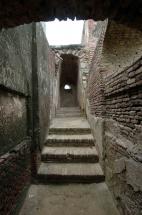
Subject: East wing (interior), dilapidated long corridor B [ref:fig.48, plan, S.Parihar, 2006], interconnecting entry portal A [ref:fig.48, plan, S.Parihar, 2006] with Chamber C [ref:fig.48, plan, S.Parihar, 2006] with descending stairs
Site Name: Sarnath
Date: 299-200 BCE
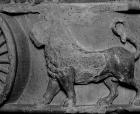
Subject: Lion capital, detail of abacus showing lion. The epigraph translates as: "His sacred Majesty King Piyadasi?.at Pata(liputta)?The Church is (not) by any one to be divided. But whosoever, monk or nun, shall break up the Church, shall be made to don white robes and made to dwell in another dwelling. Thus should this command be brought to notice in the Order of monks and in the Order of nuns.; "Thus saith his sacred Majesty. One such edict hath been inscribed at the place of assembly in order that it may be near you. And even such an edict ye must inscribe for the laity. And the laity also should come on the Sabbath-days in order to be inspired with faith in this edict. On every Sabbath-day regularly shall each superintendent ( of the Law) come to the Sabbath service to be inspired with faith in this Order and to learn it.;"And as far as your district (extendeth) ye must everywhere make (the edict) known according to the letter thereof. So, too, in all fortified towns and provinces, ye must cause it to be made known according to the letter thereof."; The second inscription which consists of a single line in length and is of the Kushana period translates as: " In the fortieth year of Rajan Asvaghosha, the first fortnight of winter, on the tenth day..."; The third inscription also consists of a single line but it is inscribed in characters of the early Gupta period. It translates as: " Homage of the masters of the Sammitiya (?) sect (and) of the Vatsiputrika school."
Site Name: Sarnath
Date: 299-200 BCE
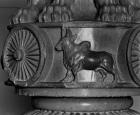
Subject: Lion capital, detail of abacus showing bull. The epigraph translates as: "His sacred Majesty King Piyadasi?.at Pata(liputta)?The Church is (not) by any one to be divided. But whosoever, monk or nun, shall break up the Church, shall be made to don white robes and made to dwell in another dwelling. Thus should this command be brought to notice in the Order of monks and in the Order of nuns.; "Thus saith his sacred Majesty. One such edict hath been inscribed at the place of assembly in order that it may be near you. And even such an edict ye must inscribe for the laity. And the laity also should come on the Sabbath-days in order to be inspired with faith in this edict. On every Sabbath-day regularly shall each superintendent ( of the Law) come to the Sabbath service to be inspired with faith in this Order and to learn it.;"And as far as your district (extendeth) ye must everywhere make (the edict) known according to the letter thereof. So, too, in all fortified towns and provinces, ye must cause it to be made known according to the letter thereof."; The second inscription which consists of a single line in length and is of the Kushana period translates as: " In the fortieth year of Rajan Asvaghosha, the first fortnight of winter, on the tenth day..."; The third inscription also consists of a single line but it is inscribed in characters of the early Gupta period. It translates as: " Homage of the masters of the Sammitiya (?) sect (and) of the Vatsiputrika school."
Site Name: Sarnath
Date: 299-200 BCE
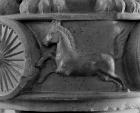
Subject: Lion capital, detail of abacus showing horse. The epigraph translates as: "His sacred Majesty King Piyadasi?.at Pata(liputta)?The Church is (not) by any one to be divided. But whosoever, monk or nun, shall break up the Church, shall be made to don white robes and made to dwell in another dwelling. Thus should this command be brought to notice in the Order of monks and in the Order of nuns.; "Thus saith his sacred Majesty. One such edict hath been inscribed at the place of assembly in order that it may be near you. And even such an edict ye must inscribe for the laity. And the laity also should come on the Sabbath-days in order to be inspired with faith in this edict. On every Sabbath-day regularly shall each superintendent ( of the Law) come to the Sabbath service to be inspired with faith in this Order and to learn it.;"And as far as your district (extendeth) ye must everywhere make (the edict) known according to the letter thereof. So, too, in all fortified towns and provinces, ye must cause it to be made known according to the letter thereof."; The second inscription which consists of a single line in length and is of the Kushana period translates as: " In the fortieth year of Rajan Asvaghosha, the first fortnight of winter, on the tenth day..."; The third inscription also consists of a single line but it is inscribed in characters of the early Gupta period. It translates as: " Homage of the masters of the Sammitiya (?) sect (and) of the Vatsiputrika school."