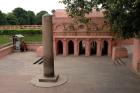
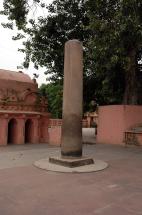
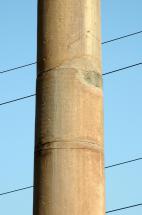
Site Name: Delhi (Hindu Rao Hospital)
Date: 269-232 BCE
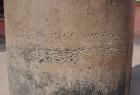
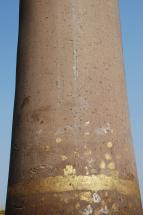
Subject: Detail, Ashokan pillar, with Ashoka's edicts I-IV


 CENTER FOR ART AND ARCHAEOLOGY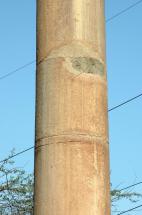
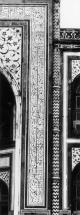
Main entrance on south to Taj Mausoleum, portal, west half: The great gate called darwaza-i rauza (gate of the mausoleum) is clad in red sandstone and white marble. White marble frames the dominant portal arch in the center and then decreases towards the corner towers. The corners are accentuated by engaged towers (minarets). At the bottom left end of the frame is the signature of the calligrapher Amanat Khan and Hijri date 1057 (1647/48 CE). The great gate doesn't have an outer dome.
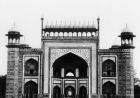
Main entrance on south to Taj Mausoleum compound, upper part: The great gate called darwaza-i rauza (gate of the mausoleum) is clad in red sandstone and white marble. White marble frames the dominant portal arch in the center and then decreases towards the corner towers. The corners are accentuated by engaged towers (minarets). At the bottom left end of the frame is the signature of the calligrapher Amanat Khan and Hijri date 1057 (1647/48 CE). The great gate doesn't have an outer dome.
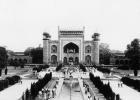
Main entrance on south to Taj Mausoleum compound, General view: The great gate called darwaza-i rauza (gate of the mausoleum) is clad in red sandstone and white marble. White marble frames the dominant portal arch in the center and then decreases towards the corner towers. The corners are accentuated by engaged towers (minarets). At the bottom left end of the frame is the signature of the calligrapher Amanat Khan and Hijri date 1057 (1647/48 CE). The great gate doesn't have an outer dome.
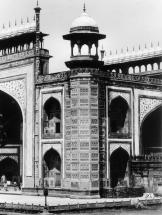
Main entrance on south to Taj Mausoleum compound, Southeast corner: The great gate called darwaza-i rauza (gate of the mausoleum) is clad in red sandstone and white marble. White marble frames the dominant portal arch in the center and then decreases towards the corner towers. The corners are accentuated by engaged towers (minarets). At the bottom left end of the frame is the signature of the calligrapher Amanat Khan and Hijri date 1057 (1647/48 CE). The great gate doesn't have an outer dome.
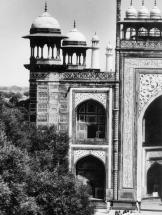
Main entrance on south to Taj Mausoleum compound, south facade, west half: The great gate called darwaza-i rauza (gate of the mausoleum) is clad in red sandstone and white marble. White marble frames the dominant portal arch in the center and then decreases towards the corner towers. The corners are accentuated by engaged towers (minarets). At the bottom left end of the frame is the signature of the calligrapher Amanat Khan and Hijri date 1057 (1647/48 CE). The great gate doesn't have an outer dome.
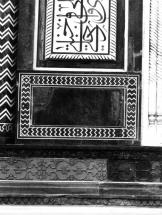
Main entrance on south to Taj Mausoleum compound, portal, east half, detail: The great gate called darwaza-i rauza (gate of the mausoleum) is clad in red sandstone and white marble. White marble frames the dominant portal arch in the center and then decreases towards the corner towers. The corners are accentuated by engaged towers (minarets). At the bottom left end of the frame is the signature of the calligrapher Amanat Khan and Hijri date 1057 (1647/48 CE). The great gate doesn't have an outer dome.
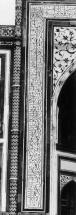
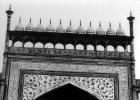
Main entrance on south to Taj Mausoleum compound, portal, upper part: The roof of the great gate is accentuated with small white marble cupolas; the north and south pishtaqs are each topped by a row of eleven cupolas (chaukhandi) set between the freestanding guldastas of the engaged colonettes that frame the central part of the facades.
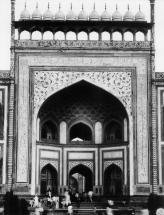
Main entrance on south to Taj Mausoleum compound, portal: The great gate called darwaza-i rauza (gate of the mausoleum) is clad in red sandstone and white marble. White marble frames the dominant portal arch in the center and then decreases towards the corner towers. The corners are accentuated by engaged towers (minarets). At the bottom left end of the frame is the signature of the calligrapher Amanat Khan and Hijri date 1057 (1647/48 CE). The great gate doesn't have an outer dome.
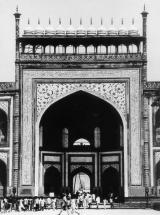
Main entrance on south to Taj Mausoleum compound, portal: The great gate called darwaza-i rauza (gate of the mausoleum) is clad in red sandstone and white marble. White marble frames the dominant portal arch in the center and then decreases towards the corner towers. The corners are accentuated by engaged towers (minarets). At the bottom left end of the frame is the signature of the calligrapher Amanat Khan and Hijri date 1057 (1647/48 CE). The great gate doesn't have an outer dome.
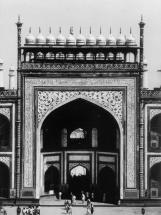
Main entrance on south to Taj Mausoleum compound, portal: The great gate called darwaza-i rauza (gate of the mausoleum) is clad in red sandstone and white marble. White marble frames the dominant portal arch in the center and then decreases towards the corner towers. The corners are accentuated by engaged towers (minarets). At the bottom left end of the frame is the signature of the calligrapher Amanat Khan and Hijri date 1057 (1647/48 CE). The great gate doesn't have an outer dome.