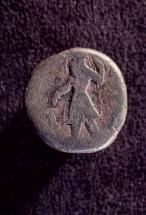
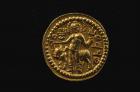
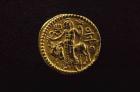
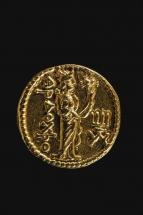
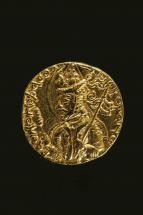
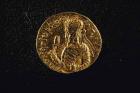
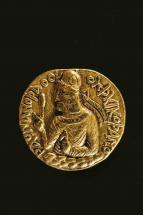
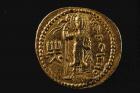
Subject: King Kanishka I standing facing left, holding long staff in left hand, sacrificing over an altar with the right hand [Copper Drachma (1/4 unit), Obverse]
Site Name:
Date: 168-206 CE
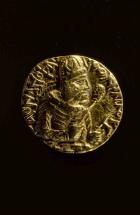
Subject: First bust type for reign; Bust of King facing right, holding club in right hand, ankusa in left; conical headdress [Gold Dinar, Obverse]
Site Name:
Date: 168-206 CE
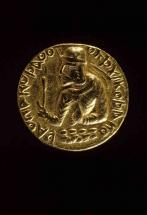
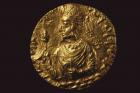
Subject: Note long side and mole on forehead. The bust emerging from the clouds probably represents a deification of kingship; Half-length bust of king facing left, holding club and ankusa, over clouds [Gold Dinar, Obverse]
Site Name:
Date: 168-206 CE
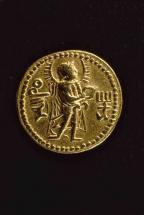
Subject: Tongs represent the association of Miiro (Mithra) with the metal gold.; Miiro (Mithra) standing facing right, radiate, holding tongs and ankusa [Gold Dinar, Reverse]
Site Name:
Date: 168-206 CE
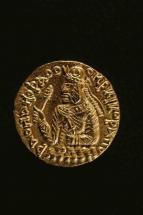
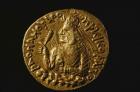
Subject: Headdress is similar to Parthian headdresses used in Iran 200 years earlier; Half-length bust of king facing left, holding club and ankusa, over clouds; wearing a tall, rounded headdress, ornamented with pearls and precious stones [Gold Dinar, Obverse]
Site Name:
Date: ca 340-360 CE
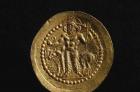
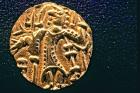
Subject: All of the Kushano-Sassanian scyphate (cup-shaped) coins were presumably struck at Balkh; Siva standing facing, holding trident and diadem; his topknot replaced by a flame-like crown, with hair in Sassanian style falling in two large balls to left and right of his head; behind him the bull Nandi, standing facing left [Gold Dinar, Scyphate, Reverse]
Site Name:
Date: 300-325 CE
Subject: All of the Kushano-Sassanian scyphate (cup-shaped) coins were presumably struck at Balkh; Siva standing facing, holding trident and diadem; his head and trident protrude above the beaded border; his topknot replaced by a flame-like crown, with hair in Sassanian style falling in two large balls to left and right of his head; behind him the bull Nandi, standing facing left [Gold Dinar, Scyphate, Reverse]
Site Name:
Date: 240-270 CE
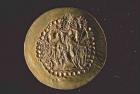
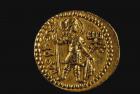
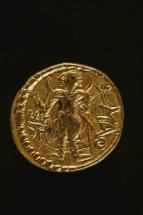
Subject: Siva standing facing, holding trident and diadem with flames around his head; behind him the bull Nandi, standing facing left [Gold Dinar, Reverse]
Site Name:
Date: 206-241 CE
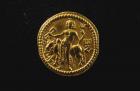
Subject: Siva standing facing, holding trident and diadem; behind him the bull Nandi, standing facing left [Gold Dinar, Reverse]
Site Name:
Date: 206-241 CE
Subject: This reverse forms the prototype for all subsequent Kushan issues produced north of the Hindu Kush; Siva standing facing, holding trident and diadem; behind him the bull Nandi, standing facing left [Gold Dinar, Reverse]
Site Name:
Date: 168-206 CE
Subject: Shaorero, god of wealth and power, standing facing right, helmeted and dressed in cuirass and armored leggings, holding tall staff in right hand, resting left hand on shield [Gold Dinar, Reverse]
Site Name:
Date: 168-206 CE
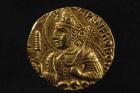
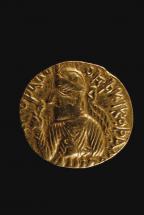
Subject: One of the finest Kushan portraits ever made.; Half-length bust of ruler facing left, holding mace in right hand, tasseled lance in left hand; he wears a pointed, conical, highly ornamented headdress. [Gold Dinar, Obverse]
Site Name:
Date: 168-206 CE
Subject: Cornucopias and bow represent a plentiful harvest and successful hunt, respectively ; Ardoxsho, goddess of plenty and fortune, standing facing right, holding cornucopias and bow [Gold Dinar, Reverse]
Site Name:
Date: 168-206 CE
Subject: Considered the latest issue of his reign. This obverse formed the prototype for the portrait coins of the Mughal Emperor Jehangir, struck in 1617.; Half-length bust of ruler facing left, holding mace in right hand, tasseled lance in left hand; he wears a pointed, conical, highly ornamented headdress. [Gold Dinar, Obverse]
Site Name:
Date: 168-206 CE
Subject: Flames emerging from shoulders are a symbol of divinity.; Half-length bust of king facing left, holding club and ankusa [Gold Dinar, Obverse]
Site Name:
Date: 168-206 CE
Subject: Half-length bust of king facing left, holding club and ankusa, over clouds [Gold Dinar, Obverse]
Site Name:
Date: 168-206 CE
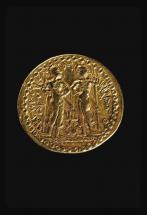
Subject: Skando-Kumaro, Bizago, and Maaseno (Mahasena) were all associated with Karttikeya, and eventually melded into the war-like Siva. ; Two standing Deities facing; Left: Skando-Kumaro, the God of War; Right: Bizago, an avatar of the God of War. Both holding staffs, with swords at their belts. [Gold Dinar, Reverse]
Site Name:
Date: 168-206 CE
Subject: Half-length bust of king facing left, holding club and ankusa, over clouds [Gold Dinar, Obverse]
Site Name:
Date: 168-206 CE
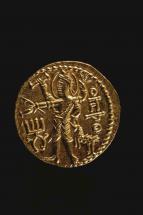
Subject: Standing, Four-armed Siva, facing left, holding drum, vajra, vase, ankusa, trident-tipped staff and an antelope by the horns; wearing necklace of beads or talismans [Gold Dinar, Reverse]
Site Name:
Date: 168-206 CE
Subject: Provincial style of undetermined mint; evidenced in large head in proportion to size of body; Half-length bust, facing right, radiate, holding tongs and ankusa [Gold Dinar, Obverse]
Site Name:
Date: 168-206 CE
Subject: Lunar god Mao standing, facing left, with lunar crescent behind shoulders, holding orb-tipped staff in left hand; right hand in characteristic two-finger gesture [Gold Dinar, Reverse]
Site Name:
Date: ca 400 CE
Subject: Kidara was apparently related to Peroz, whose names appear on some Gandharan coins; he was probably of Hunnish origin, not a Kushan. He took on Kushan regalia as their successor in Gandhara.; Standing King sacrificing with right hand and holding trident in left. The name Kidara appears below the King's arm, Kushana at far right, with an additional word generally read as kapa or Kapan to the left of his feet. [Gold Dinar, Obverse]
Site Name:
Date: 168-206 CE
Subject: Maaseno is a deity of war.; Maaseno standing, facing, holding eagle-tipped scepter in right hand, a sword in his left hand is held in front of his stomach [Gold Dinar, Reverse]
Site Name:
Date: 168-206 CE
Subject: Half-length bust of king facing left, holding club and ankusa, over clouds; prominent wart on Huvishka's cheek [Gold Dinar, Obverse]