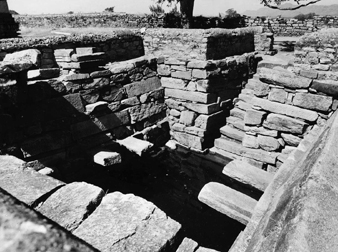
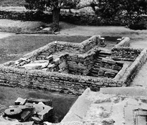
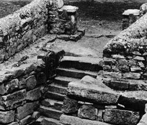
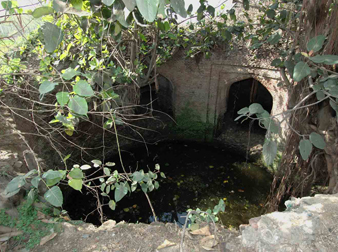
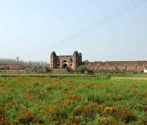
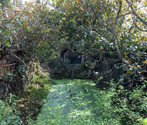
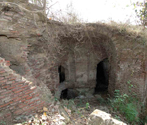
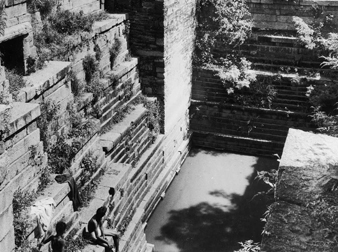
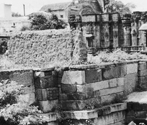
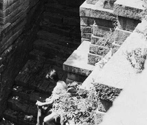
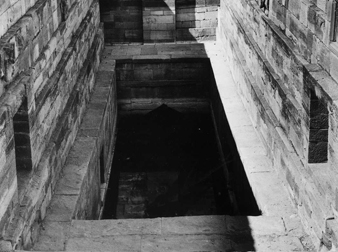
The stepwell is located near Sarai Amanat
Khan’s Western gateway on the Tarn Taran–Attari Road in Tarn Taran district of Punjab.
The stepwell has a well at the southern end and a double-storied entrance
gateway at the northern end, initially with three rooms. The well was restored before
the documentation but remained dry and unused. Its architectural style and
proximity to the Sarai suggest a connection to Amanat Khan.
The stepwell at Doraha is a Mughal-period stepwell located to the south of the rest house Sarai Doraha in Ludhiana district of Punjab, and probably constructed between 1611-1620 CE contemporaneously with the sarai. It is built of brick and lime mortar and extends over 46 metres in length, incorporating a large circular well and an adjoining chamber with arched openings facing the well shaft. The structure is unprotected and survives in a deplorable condition, with substantial portions submerged due to a rise in the water level.
A historic stepwell located to the east of the Grand Trunk Road in the northern part of Mathura town & district of Uttar Pradesh. Of uncertain date and patronage, the stepwell is constructed of lakhori bricks, red sandstone, and lime mortar, with steps on the west side and arched niches along the eastern walls. The structure is unprotected and heavily damaged; it is now completely dry, filled with debris, and partly submerged, and is currently used as a dumping area by local residents, with additional modern construction within the well and surrounding tomb structures nearby.
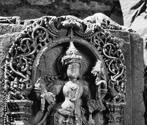
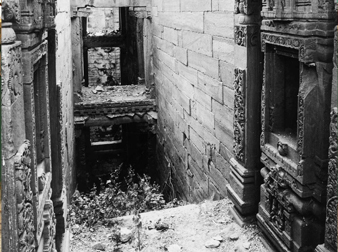
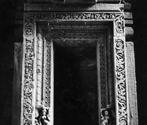
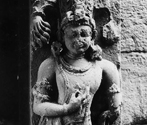
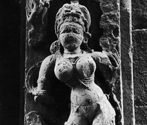
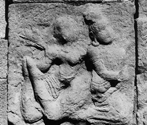
The stepwell is built on an L-shaped plan. It is partly in a ruined condition and partly repaired by the villagers with concrete and plaster all over. This stepped corridor descends with five storeys deep into the earth. The stepwell does not have much carved ornamentation, except some sculptures in niches. The sculptures are: in kuta two sculptures of goddess Amba Mata and Bhairava; in kuta three on the third storey, there is a niche filled with floral ornamentation. One can identify a woman giving birth to a child and four women attending to her, all arranged in a long row. In a niche next to this is a sculpture of Sesasayin Vishnu.
Reference: Jain-Neubauer, Jutta. The Stepwells of Gujarat: In Art-historical Perspective, 2003.
The Stepwell at Babri Mod, Hodal, Palwal
district, Haryana, is a stepwell tentatively dated to 1775–1800 CE and
attributed to Kashi Ram Choudhary. Built of rubble masonry, sandstone, and lime
mortar, the stepwell represents the continued tradition of Mughal-period
hydraulic architecture in the region.