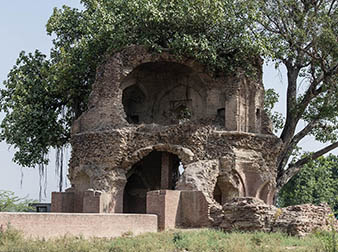
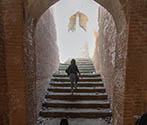
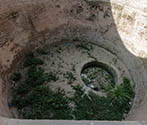
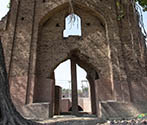
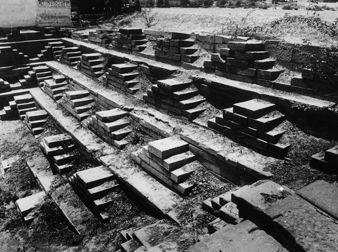
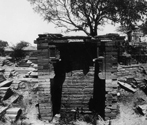
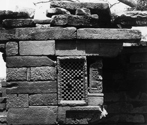
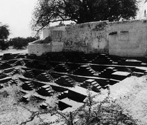
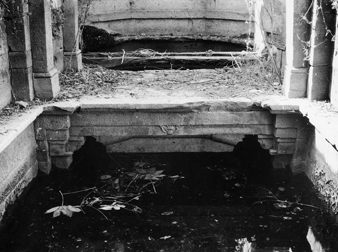
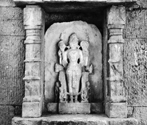
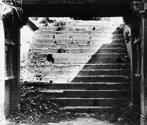
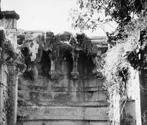
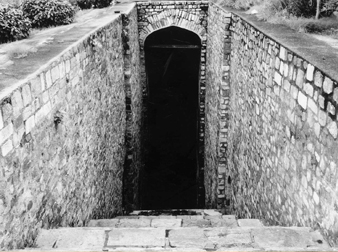
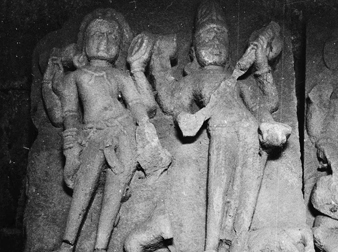
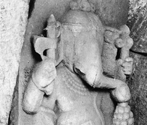
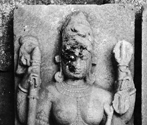
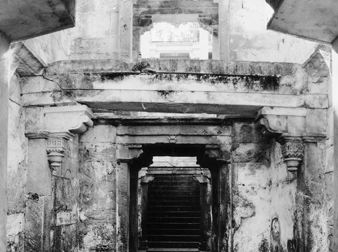
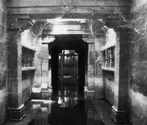
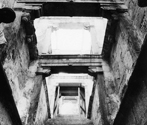
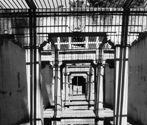
The stepwell is built on an L-shaped plan. It is partly in a ruined condition and partly repaired by the villagers with concrete and plaster all over. This stepped corridor descends with five storeys deep into the earth. The stepwell does not have much carved ornamentation, except some sculptures in niches. The sculptures are: in kuta two sculptures of goddess Amba Mata and Bhairava; in kuta three on the third storey, there is a niche filled with floral ornamentation. One can identify a woman giving birth to a child and four women attending to her, all arranged in a long row. In a niche next to this is a sculpture of Sesasayin Vishnu.
Reference: Jain-Neubauer, Jutta. The Stepwells of Gujarat: In Art-historical Perspective, 2003.
The Stepwell at Babri Mod, Hodal, Palwal
district, Haryana, is a stepwell tentatively dated to 1775–1800 CE and
attributed to Kashi Ram Choudhary. Built of rubble masonry, sandstone, and lime
mortar, the stepwell represents the continued tradition of Mughal-period
hydraulic architecture in the region.
The Kanech stepwell is located in agricultural
fields outside the village, near the road connecting NH-1 to Kanech in Ludhiana
district of Punjab. Built of brick and lime mortar, the structure comprises a
stepped descent leading to a square chamber opening into a large circular well,
with an octagonal platform and a small ancillary tank on the exterior. Although
sometimes attributed to the Sikh period, its architectural form closely
parallels the stepwells at Doraha, suggesting a Mughal-period date. The stepwell
is unprotected and survives in fair condition, with extensive wild vegetation
covering parts of the structure.