Galleries

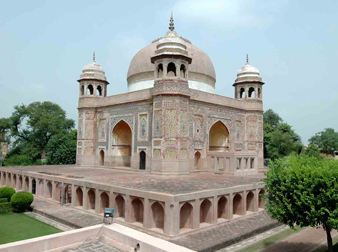
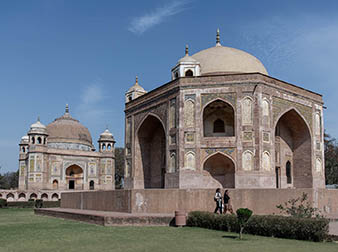
Hadironwala Bagh, Nakodar, Punjab

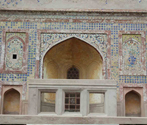
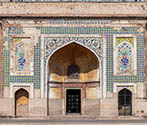
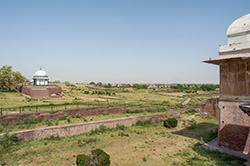
Located in Nakodar (Amardas Colony) in Jalandhar district of Punjab, this funerary complex comprises two Mughal-period tombs traditionally known as the tombs of Ustad and Shagird (Teacher and Disciple). The tomb of Muhammad Momin al-Husayni dates to 1021 AH (1612–13 CE), while the tomb of his disciple Haji Jamal was constructed in 1057 AH (1656–57 CE). Distinguished by octagonal and square plans respectively, both tombs display refined glazed-tile decoration and Quranic inscriptions. The monuments stand opposite each other within the remains of a former garden setting and are under the protection of Archaeological Survey of India (Chandigarh Circle).
Collection type:

Galleries

Harsh Ka Tila, Thanesar, Haryana

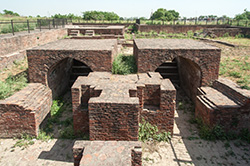
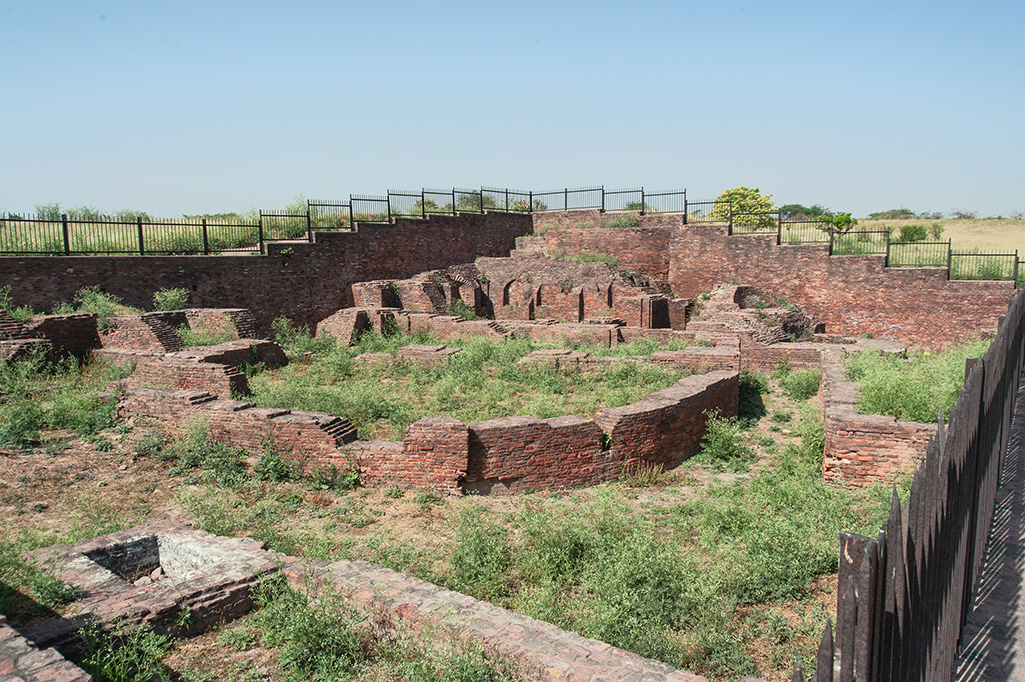
Harsh ka Tila is an extensive archaeological mound located near the Sheikh Chilli complex in Thanesar in Kurukshetra district of Haryana. Identified with ancient Sthanesvara, the site has yielded structural remains and artefacts from successive historical periods through systematic excavations. Objects recovered from Harsh ka Tila and nearby Bhagwanpura are displayed in the site museums within the Sheikh Chilli complex. The site is protected by the Archaeological Survey of India (Chandigarh Circle).
Collection type:

Galleries

Haryana (Architectural Drawings)

Haryana (Architectural Drawings)

Collection type:

Galleries

Haveli and Kacheri, Hodal, Haryana

The Old Kacheri (also known as the Haveli of Chaudhary Kashi Ram) is a late Mughal-period courthouse complex located at Andooa Patti, Hodal, in Palwal district, Haryana. Tentatively dated to around 1750 CE and attributed to Chaudhary Kashi Ram Sorot, the structure appears to have functioned as an izlaas khas (courtroom) or local judicial hall. Constructed of lakhori bricks, sandstone, and lime mortar, the complex features a prominent double-storeyed gateway on its northeast facade, reflecting elements of late Mughal domestic and administrative architecture. 

Collection type:

Galleries

Hazrat Shah Najm-al-Haq, Sohna

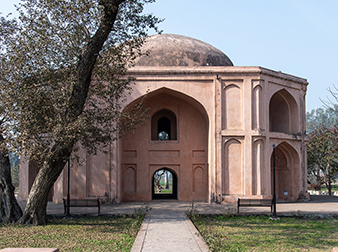
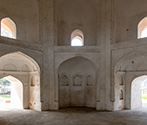
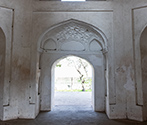
A part of primary school now, the complex comprises a tomb, Masjid and an entrance gateway within a walled enclosure. Masjid forms a part of the wall facing the courtyard, while the tomb is located in the center of the courtyard. The entrance gateway leads into the courtyard and provided access to the tomb and Masjid. It is a single storied, square structure constructed of red and buff stone where the exteriors are is left unplastered. Interior space is covered with a dome resting on an octagonal base topped with an inverted lotus; the walls are plastered and adorned with niches of various sizes at different levels. The exterior of this structure are fairly simple with entrance and exit recessed archways and a band of crenellations at parapet level. The Masjid is a single storied, rectangular pillared hall constructed of stone and delineated into three bays. A flat ceiling with three domes covers the interior space; the domes are ribbed and topped with inverted lotus. Main façade is formed by a series of arches topped with a row of brackets supporting a continuous chajja and a decorative parapet above. The Tomb is a square structure located on a raised platform. A continuous chajjas runs around the structure supported over brackets. Interior space is covered with a ribbed dome, resting on an octagonal drum. The parapet and the octagonal drum are embellished with detailing in plaster.

Collection type:

Galleries

Helical well, Champaner, Gujarat

The Helical stepwell is situated at the foot of a hill near the town of Pavagadh. It is altogether a small monument, measuring in all not more than 19 metres. It consists mainly of the shaft of the well, and a short entrance staircase which leads into a spiral stairway. This spiral stairway is attached to the wall of the well and descends downwards like the ‘coils of a snake’. The idea of circumambulation is expressed in the spiral stairway. This stepwell reflects the very early stage of stepwell architecture.


Reference: Jain-Neubauer, Jutta. The Stepwells of Gujarat: In Art-historical Perspective, 2003.

Collection type: