Galleries

Kokkurani, Baroque Architecture, Ta...

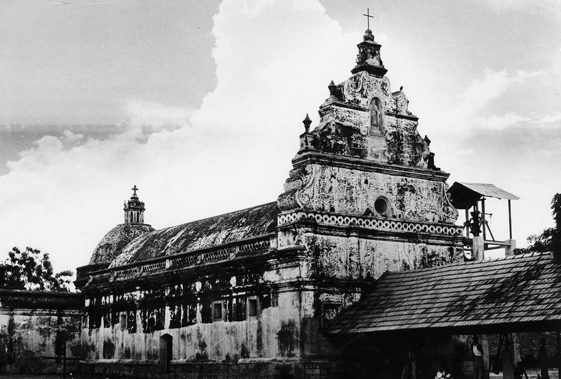
Kokkurani, Baroque Architecture, Tamil Nadu

Collection type:

Galleries

Koranganatha temple, Srinivasanallu...

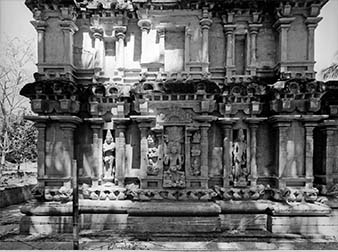
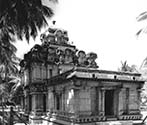
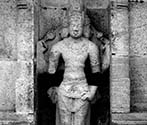
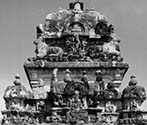
The Koranganatha temple at Tiruchirapalli (Tamil Nadu) stands in a built-in pit and is of modest proportions. This temple has a re-engraved inscription from the time of early Chola ruler Aditya I (871 - 907 CE), and four inscriptions of Chola Parantaka's time (907 - 954 CE). The fabric of the temple is not of Aditya's time but rather of rebuilding during Parantaka I's time (927 CE). The entire composition displays a return to earlier Pallava simplicity and marks the transitional period between the Pallava and Chola - the base is of stone and the upper levels are in brick. The now empty sanctum sanctorum (garbhagriha) originally contained a lingam. The pilasters embedded in the wall are adorned with beautiful sculptures and the arches have delicately carved frieze work. The crowning dome or sikhara is four-cornered and curvilinear with the same four niches, topped by chaitya arches. The shrine was desecrated at some later date by a monkey as is evident from its present name of Koranganatha - Lord of the Monkeys. References: M. Boothalingam, 1971, p.16 & pp. 29-37, K. Deva, 1995, p.224 and M.W. Meister and M.A. Dhaky 1963, p.170, V. Dehejia, 1990, p.22.

Collection type:

Galleries

Kos Minar & Unidentified Tomb, Sika...

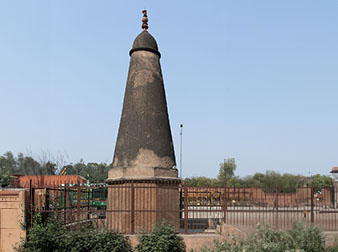
A Mughal-period distance marker located south of the Grand Trunk Road near Kailash Mod, Sikandra (Maharshipuram Colony) in Agra district of Uttar Pradesh, with Akbar’s Tomb situated to its east. Probably constructed in the 17th century CE, the octagonal structure is built of lakhori bricks with lime mortar and plaster and stands on a low square platform. Notably, it is crowned with a red sandstone amalaka-shaped finial. The monument is protected by the Archaeological Survey of India (Agra Circle). A domed rectangular tomb of uncertain date and patronage stands immediately west of the kos minar, built of lakhori bricks with lime mortar and plaster, with arched niches on its eastern facade.

Collection type:

Galleries

Kos Minar & Well, Kurtail, Haryana

A Mughal-period distance marker located about 100 metres east of National Highway 44 (Old Grand Trunk Road), behind a factory at Kutail, Karnal, Haryana. Probably constructed between 1600 and 1699 CE, the octagonal tower is built of lakhori bricks with rubble masonry and lime mortar, and stands on a brick platform with a ring moulding between the octagonal base and cylindrical shaft. The monument was notified as a protected structure on March 27, 1919, and is protected by the Archaeological Survey of India (Chandigarh Circle). It remains well maintained, with minor cracks and surface blackening visible; a well is situated to the south of the minar.

Collection type:

Galleries

Kos Minar (North), Gharaunda, Harya...

A Mughal-period distance marker located about 2.5 kilometres north of Gharaunda, between National Highway 44 (Old Grand Trunk Road) and the railway track in Karnal, Haryana. Probably constructed between 1600 and 1699 CE, the octagonal tower is built of lakhori bricks with rubble masonry and lime mortar, and stands on a brick platform with a ring moulding between the octagonal base and cylindrical shaft. The monument was notified as a protected structure on December 2, 1914, and is protected by the Archaeological Survey of India (Chandigarh Circle). It remains well maintained, though minor cracks and surface blackening are visible.

Collection type:

Galleries

Kos Minar (North), Karnal, Haryana

The Kos Minar (North) at Karnal (Minar Road), Karnal district, Haryana, is a Mughal-period structure dating to 1600–1699 CE and is constructed of lakhori bricks with lime mortar. The monument is currently protected and maintained by the Archaeological Survey of India (Chandigarh Circle).

Collection type: