


 CENTER FOR ART AND ARCHAEOLOGY
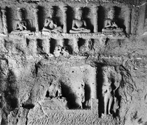
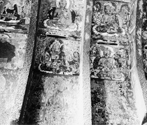

Cave 10 is the earliest chaitya (sanctuary) at Ajanta that started in 1st BCE. The cave carries inscriptions from different donors indicating that the cave was based on community efforts, rather than the private benefactions of elite donors, as was the case in Ajanta’s Vakataka phase. There is a monolithic stupa, which preserves a fragment of later Vakataka repainting. The facade of the cave was probably at first of wood, but at a later date the lower portion of it, at least, was built of very large brick, which has now disappeared.
From the Chinese pilgrim Fa Hien’s records, it is known that that the site was active around 400 CE; however, the site may have had its problems in the period between the second and the fifth century when Buddhism was in decline. The cave contains paintings of different periods. Only a few early Buddhist period paintings remain in the cave, all much obscured and covered with later images. A sequence of paintings showing scenes from the life of the Buddha, appears on the left wall while Jataka stories Sama Jataka and the Chhaddanta Jataka are depicted on the right wall. The later Vakataka period paintings are better preserved and contain Buddha figures in various poses mainly over the pillars.
The principal paintings are: ‘The Arrival of the Raja with his Retinue’ on the rear wall of the left aisle, ‘The Royal Party Worshipping at a Stupa’ on the left hand wall behind pillars nine to eleven; ‘The Royal Party Passing Through a Gateway’ on the left-hand wall behind pillars eleven to fifteen and various figures of Buddha painted on different pillars. The cave contains the largest number of painted records.
References:


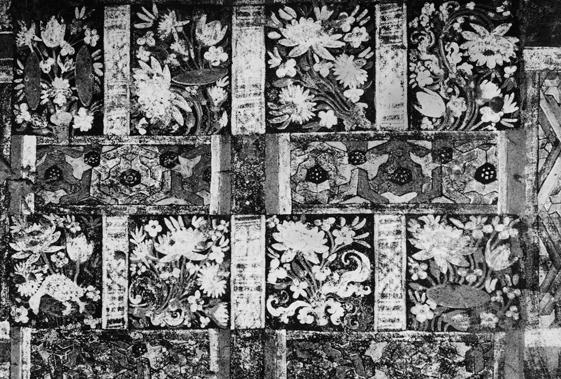


Cave 11 was one of the first excavations undertaken in 462 CE during the Vakataka phase by an unidentified patron. It is squeezed between and above the Cave 10 and its associated residence, Cave 12. When the excavation for Cave 11 was started in 462 CE, there was nothing else there except for the ancient caves that were still in worship. Like all of the earlier Vakataka viharas, it was planned as a simple and functional hall to be served as a dormitory. At each end of the verandah there are two cells that approached by a flight of steps and the outer cells have collapsed. The right wall of the verandah is carved with figures of Buddha in three panels. The door is plainly molded with a lion-heads at each end of the threshold. The plinth, on which the simhasana of Buddha rests, contains the kneeling figure of a devotee. Higher up in the left wall is hewn out a secret chamber probably for storing valuables. The roof of the verandah along with its projection is covered with painted motifs including varied flora, birds, beast, geometric designs etc. The back walls of the verandah immediately to the left and right of the door are painted with large-size Boddhisattvas with attendants, large portions of the paintings being damaged, the walls of the hall are painted mostly with figures of Buddha.
The cave doesn’t have an antechamber, one can see a half-finished cell at the rear that had to be converted to satisfy the new demand for a Buddha shrine, which was not started until some seven years after the cave had been begun. The shrine has an unfinished image of Buddha seated in padmasana pose with the hands in dharmacakra mudra fronts an abandoned stupa. The Cave 11 Buddha image was probably the first to have been conceived at the site before conventions had been set. It is the only image at the site earlier than 475 CE to incorporate a standalone kneeling devotee at the base instead of conventional pairs or groups found under late carved Buddha images.
Cave 11’s planned program of painting was never completed because of the strictures of the Recession. All of the hall paintings and most of the porch paintings are intrusions dating between mid-478 and 480 CE. Like most of the other caves at the site, Cave 11 must have been abandoned shortly after 480 CE by which time any active patronage either original or intrusive had ended.
References:
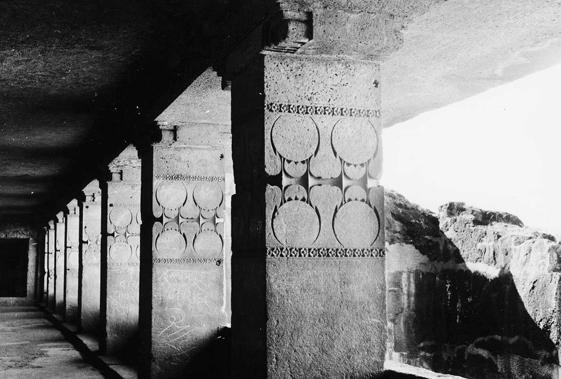

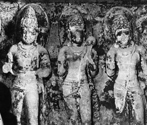


Cave 12, an early Buddhist vihara (monastery) is one of the oldest hewn and most probably belongs to first century BCE. In its own heyday, the cave probably housed many of the monks associated with the great chaitya hall, Cave 10. An inscription on the back wall of the monastery records the gift of a cell by one merchant called Ghanamadada. The walls of the hall above the cell-doors are ornamented with chaitya window motifs connected at places by a railing motif; the right wall is decorated with stepped merlons of Assyrian pattern.
The monastery once bore paintings of which hardly anything now exists. The cave’s pillar-less hall is surrounded by carefully cut cells, each with two stone beds and that once must have housed at least twenty-four monks. The cave must have provided a ready model for the new excavators, who copied its typically astylar, shrineless plan quite directly during the first years of Vakataka.
During the time of the site’s renewal in the fifth century, this vihara must have been put to use as a residence for the craftsmen, which is suggested by the typically “late” red-brick plaster on the walls that is associated with the Vakataka building activity.
References:


