CENTER FOR ART AND ARCHAEOLOGY

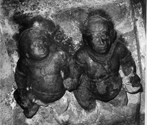

Cave 16 is the largest vihara (monastery) of Ajanta and commenced in the 460s and was completed by Asmakas, the feudatories of the Vakatakas. The monastery with its colossal hall, ornate doors and windows, painted galleries, sculptures, ornamented pillars and a cistern was the gift of Varahadeva a minister of Emperor Harisena. Although, this vihara introduced the pillared hall to the site, it was started so early that it was soon regarded as old-fashioned. Nevertheless, the image and its chamber in the interior shrine for Buddha were carved in an innovative form. The Buddha image is shown seated in pralamba-padasana or English chair posture and the sanctum is devoid of an antechamber or a doorway.
Originally, the entire cave was painted but now very little of the painting now remain. Several interesting scenes Hasti, Maha-ummagga, Maha-sutasoma jataka tales are depicted. Other murals show the conversion of Nanda, miracle of Sravasti, Sujata's offering, Asita's visit, the dream of Maya, the Trapusha and Bhallika story, and the ploughing festival.


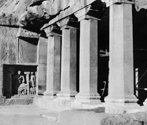

Cave 17 was started immediately after Cave 16 in the 460s. It is first of the cluster of excavations (Caves 17, 18, 19, 20, 29) sponsored by Upendragupta, the feudatory ruler of the Ajanta region. While he was a prime force in the site’s renaissance in the middle of fifth century, he may have spent too much wealth on religious pursuits, and not enough on the implements of war. In the 470s CE he suffered a defeat at the hands of the rival Asmakas and all work on his caves including Cave 17, came to a sudden halt.
The verandah of this cave has massive pillars in the front. The main hall has three entrances, and the central door is adorned with carvings. The twenty columns dividing the corridors on the four sides of the hall are lavishly carved and painted. Beside the two cells in the verandah, this cave contains sixteen cells and a cistern of water. The shrine contains a massive figure of Buddha in dharmachakra mudra or Teaching attitude that is flanked by the Boddhistava Padmapani on the right and Vajrapani on the left.
This cave has thirty major murals that are well preserved and include a huge and gigantic wheel representing the ‘Wheel of Life’, flying group of Celestials (Gandharvas and apsaras), a damsel wearing beautiful headgear, story of subjugation of Nalagiri (a wild elephant) by Buddha and Buddha preaching to a congregation all depicted in veranda. The Jatakas depicted inside the cave are Chhaddanta, Mahakapi, Hasti, Hamsa, Vessantara, Maha-Sutasoma, Sarabha-miga, Machchha, Matruposaka, Sama, Mahisa, Valahass, Sibi, Ruru, Nigrodhamiga and Simhalavadana. Buddha offering his begging bowl to his son Rahula is depicted to the right of the sanctum. Some scenes also incorporate themes from everyday society and culture such as a shipwreck, a princess applying makeup, lovers in scenes of dalliance, and a wine drinking scene of a couple with the woman and man amorously seated.


Cave 18 is an elaborate cistern chamber that also functions as a pillared passage linking Upendragupta’s Caves 17 and 19. It commenced in 463/464 CE and was sponsored by Upendragupta, the sub-king at Ajanta. This water-channel, probably served both of its adjacent caves - Caves 17 and 19. An inscription in Upendragupta’s Cave 17 on a wall shared that the cistern shares with the cave’s court honors it with a special reference to its always being “filled with sweet, light, clear, cold and copious water”.
References:
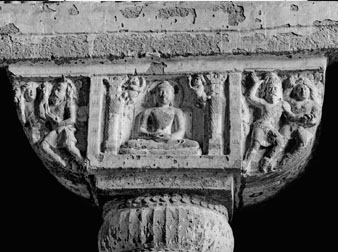
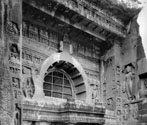
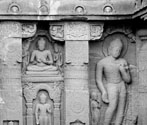
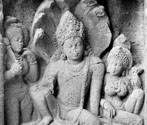
Cave 19 is Upendragupta’s “perfumed hall” that commenced in 470s. It was conceived originally as the devotional focus of the site. The exquisite facade of this chaitya-griha (monastery) with its pillared portico and projected cornice is dominated by chaitya window in the facade. This apsidal cave is divided into a nave, an apse, and aisles by colonnade of seventeen pillars. At the center of the apse stands a stupa and an umbrella wholly in stones reaching almost to the roof of the cave. The roof of the aisles has been painted chiefly with ornamental flower scrolls.
Cave 19’s motifs served as models for much later work but before the hall could be put into worship, the victorious Asmakas took over the region, broke a path through its forward court cells in order to more easily reach their own rival Cave 26, and forbade this cave’s use. Later on, in mid 478–480 CE, during the disruption of authority over the site following Harisena’s death, the eager donors covered Cave 19’s court extensions with intrusive votive images. For instance, the famous cobra king (Nagaraja) at the left would originally have been paired with another ancient divinity at the right; but since Upendragupta’s program was never completed, an intrusive seated Buddha, his seat planted on the ground in a characteristically late way, was placed there instead.
References:
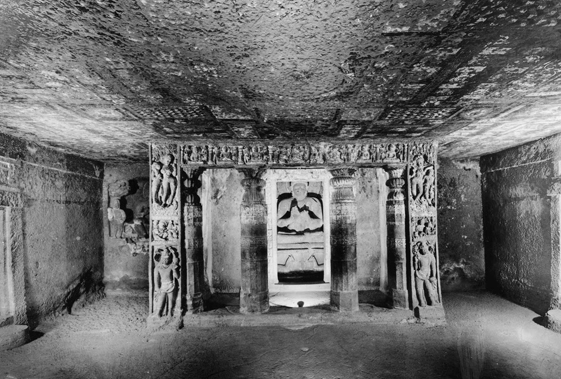


Cave 20 is a richly colonnaded vihara or monastery on which work started in 470CE. The pilaster at the left end of the verandah contains a fragmentary inscription recording the gift of the mandapa by one Upendra. This cave had to be hastily dedicated and then abandoned because of the Asmaka takeover in the early 470’s. It has a difficult history since, more than Upendragupta’s other caves, it suffered from cutbacks during the Recession. As a result, parts of Cave 20’s main Buddha image had to be expediently completed with mud plaster just before work on the cave broke off in 471 CE. This vihara presents a new feature in its antechamber advancing into the hall. The pillars and pilasters of the verandah, while resembling those of Cave 1, have bracket figures of graceful sala-bhanjikas on each side of the capitals. The roof of the verandah has imitation beams and rafters. The design of the lintel of the door with two arches, in the firm of elephant’s trunk issuing from the mouths of makaras (sea creatures in Hindu mythology) is again an innovation. The capitals of the pillars’ antechamber support an entablature carved in panels with seven Buddhas accompanied by attendants. The hall has no pillars, and some of the cells are somewhat unfinished. Most of the paintings have disappeared.
References: