

 CENTER FOR ART AND ARCHAEOLOGY
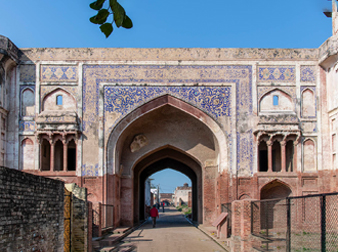
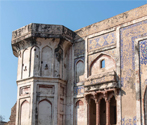
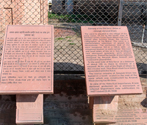
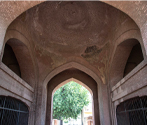
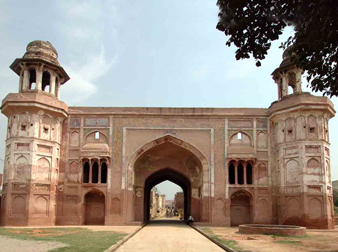
Sarai Amanat Khan is a Mughal-period caravansarai
or rest house in a village of the same name on the Tarn Taran–Attari Road in
Punjab. An inscription on the eastern gateway dates it to 1050 AH (1640–41 CE)
and credits Abd al-Haqq Shirazi, known as Amanat Khan, the Persian calligrapher
of Shah Jahan’s court who also worked on the Taj Mahal. The Sarai includes a
mosque with Arabic calligraphy in thuluth script recording his role in its
design. Built around a large square courtyard, it features glazed tiles
reflecting Persian influence and gateways with floral arabesque spandrels. Only
two octagonal bastions survive today, though each corner once had bastions
topped with chhatris. Residents recall a once-busy bazaar run by Khatri traders
that lasted until the late 20th century. The complex also contains later
structures, including houses, a haveli, and two wells, showing layered
settlement. Families living here since before Partition still occupy and have
adapted the Sarai for modern use.
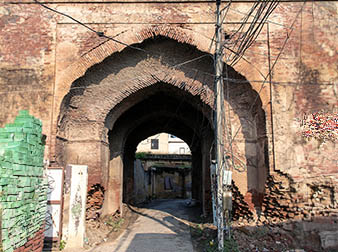
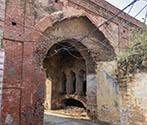
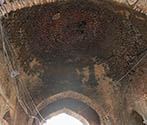
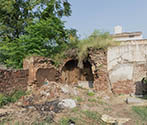
Sarai Banjara is a late Mughal–period rest house located within the village settlement of Sarai Banjara in Patiala district of Punjab. The sarai likely dates between ca. 1650-1750 CE and appears to have replaced an earlier kaccha sarai that existed during Jahangir’s reign. Of the original complex, only a single gateway survives, with its plinth now buried approximately twelve feet below the present ground level. Flanking rooms remain visible on either side of the gateway, indicating the former scale and organization of the sarai
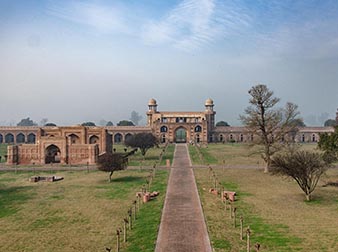
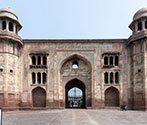
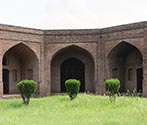
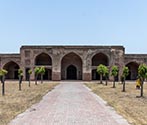
Sarai Dakhni is a well-preserved Mughal-period caravansarai or rest house located amid fields west of the Nakodar–Kapurthala Road near Mahlian Kalan in Jalandhar district of Punjab. Built during the reign of Shah Jahan (r. 1628–1658) by Muqarrab Khan Deccani, also known as Rustam Khan Bahadur Firuz Jung, the sarai follows a square plan with imposing east and west gateways, corner octagonal bastions topped by domed pavilions, and a courtyard surrounded by rows of cells. Constructed of lakhori bricks with red sandstone, glazed tiles, and lime mortar, the complex includes a mosque in the southern enclosure, noted for its floral wall paintings, and evidence of a former hammam nearby. Declared a protected monument by the Archaeological Survey of India (Chandigarh Circle) in 1919, the sarai survives in good condition, though it shows surface weathering and loss of some glazed decoration.
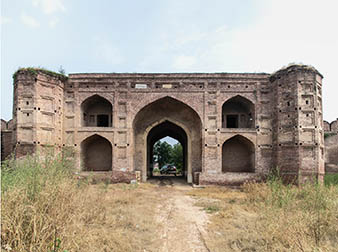
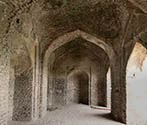
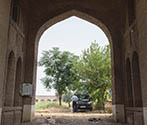
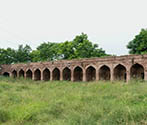
Sarai Lashkar Khan is a late Mughal caravansarai
or rest house located near Kot Panaich in Ludhiana district of Punjab,
approximately 300 metres southwest of the Grand Trunk Road. An inscription on
the eastern gateway records its construction in 1080 AH (1669–70 CE) by Lashkar
Khan, a Mughal military general under Emperor Aurangzeb. Built of lakhori
bricks with red sandstone and lime mortar, the sarai is planned as a square
enclosure with double-storied gateways, octagonal bastions, rows of cells, a
mosque in the southern half of the courtyard, and two wells. The monument is
protected by the Department of Cultural Affairs, Archaeology and Museums,
Punjab and survives in generally good condition, set within an open rural
landscape, with minor surface weathering and vegetation growth visible.
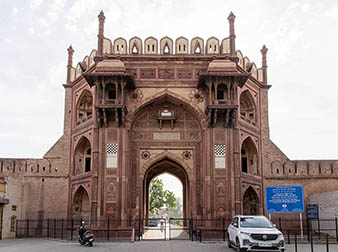
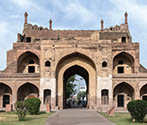
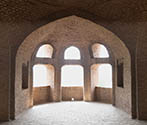
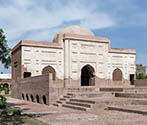
Sarai Nurmahal is a Mughal-period rest house
located to the south of Nurmahal town in Jalandhar district of Punjab. An
inscription records its construction between 1028–1030 AH (1618–21 CE) under
the patronage of Nur Jahan Begum, through her governor, Nawab Zakariya Khan.
Planned as a square enclosure with octagonal corner bastions, the sarai
features a monumental western gateway richly carved with figural, floral, and
geometric motifs, as well as a mosque and a hammam within the courtyard. Today,
the monument is under the Archaeological Survey of India (Chandigarh Circle) with
portions adapted for public use.
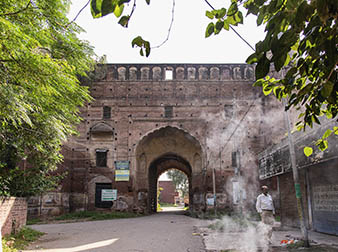
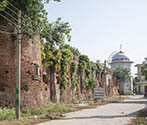
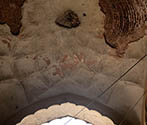
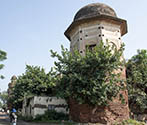
Sarai Raja Todar Mal at Rajpura is a Mughal-period caravansarai or rest house located in the centre of Rajpura town in Patiala district of Punjab. Although the monument bears no inscription, architectural features particularly the use of cusped arches in the gateways, corner bastions, and interior rooms suggest a date during the reign of Shah Jahan (r. 1628–1658) or slightly later, possibly associated with Raja Todar Mal, a Mughal official of the Sirhind region. Constructed of brick and lime mortar, the sarai is laid out as a fortified rectangular enclosure with octagonal corner bastions and two monumental gateways on the longer sides. The structure is unprotected and survives in fair condition, with substantial portions of the original fabric intact; it is presently adapted for use as the tehsil court and is locally known as the Kachehri.